


Around 1989, near the end of the regular Army’s move to the M1, I was in the 19K transition course, a school to train people on the new tank. (19K is the Army’s job code for an M1 tank crewman.) The school used M1A1 tanks, not the original M1. One person in the course was an E6 who’d spent over ten years on the older M48A5s, M60A1s and M60A3s. He griped constantly. No azimuth indicator, so how are you supposed to set up range cards? No HEP. No anti-personnel round. And on and on. (An azimuth indicator is a dial that shows which way the turret is pointed, and a range card is the crew’s sketch of where its targets are. HEP is a high-explosive round, and an anti-personnel round, or APERS, is basically a giant shotgun shell for use against troops.) The big one came when he tapped the blow-off panels over the ammo bustle and said, “there is no way I want a tank with flimsy armor like this.” (The bustle is the box on the back of the turret where the main-gun rounds are stored.)
Some of his gripes sounded fair. But the missing rounds weren’t the M1A1’s fault. By then the Army had already dropped HEP and APERS from the load, and even the last M60A3s in the regular Army and the Guard weren’t carrying them. That was a doctrine call, and he blamed it on the new machine.
On the panels he had it exactly backwards. They aren’t armor that failed. They’re built to fail, so an ammunition cook-off vents up and away from the crew instead of through them. (A cook-off is when the stored rounds catch fire and explode.) He was griping about the one feature most likely to save his life.
Don’t take my word for it. In this test footage of the XM1, the Abrams prototype, a production-line tank takes eight hits and then drives off the test stand. Then you see the ammo compartment do its job. The blow-off panels vent the blast, and the armored doors protect the crew compartment.
That’s the Luddite lesson in a nutshell. The fight is almost never about the machine. It’s about how people decide to use it. And doctrine can change again: once Iraq’s urban fighting demanded it, the Army type-classified the M1028 canister round in 2005 and rushed it to the troops there. Which brings me to a bunch of English weavers in 1811.
Why I’m writing this
Back in June I wrote The Eternal Panic. My point was simple. We’ve panicked about new writing tools for 2,400 years, and AI is just the latest one.
A reader pushed back, and I’m glad he did. Waste Books Of Ravenser Odd left a thoughtful comment. Here’s part of it:
“It’s commonly misconceived that the Luddites were against technology. They don’t appear to have been so: rather, they fought the loss of livelihood (by the debasement of their skilled labour) precipitated by automation - and the resulting starvation of their children.”
I wrote back: “I believe I was pretty clear about Luddites, but perhaps a bit too glib and one-dimensional. A whole post on the topic may be in order.”
And yes, a post on the topic is in order. Understanding the Luddites is important. It’s a tale that didn’t begin and end in the early 19th century. You will see that tale repeated over and over during the next 2 centuries. Here’s the story.
What everyone thinks a Luddite is
Today “Luddite” means someone who’s scared of technology. Your uncle who won’t get a smartphone. The guy who still pays bills with checks. In 1984 the novelist Thomas Pynchon wrote an essay asking if it was “O.K. to be a Luddite,” meaning someone who opposes technological progress.
But that story of the Luddites is factually wrong. It’s almost the inverse of that. As historian Kevin Binfield, who collected their letters and songs, put it in an article in Smithsonian Magazine, the Luddites “were totally fine with machines.”
Nottingham, 1811
Picture England at the start of the 1800s. The country had been at war with Napoleon’s France for years. Blockades, war, disrupted farming had led to scarce food supplies and high inflation. Work was drying up outside of the war effort. Times were very hard.
On March 11, 1811, in Nottingham, British troops broke up a crowd of workers protesting for more work and better pay. That night, angry workers smashed textile machines in a nearby village. The attacks spread. The attacks and battles continued over several years and covered about 70 miles of northern England, from Loughborough to Wakefield. The last of them came in 1816.
Although portrayed today as people destroying technology, these weren’t peasants who’d never seen a machine. Many were skilled machine operators. And the machine they went after most, the stocking frame, wasn’t new. (A stocking frame is a hand-powered knitting machine for stockings and other knit goods.) An Englishman named William Lee had invented it more than 200 years earlier. Machine breaking as a protest wasn’t new either. It had gone on in Britain since at least the 1760s. And actually will continue, on and off, through the years well into the 20th century.
What they actually wanted
So why break the machines? Because of how the owners were using them.
Binfield says the Luddites went after manufacturers who used machines in what the workers called “a fraudulent and deceitful manner” to get around normal labor practices. “They just wanted machines that made high-quality goods,” Binfield told Smithsonian, “and they wanted these machines to be run by workers who had gone through an apprenticeship and got paid decent wages. Those were their only concerns.”
Lord Byron saw the same thing. In his first speech to the House of Lords, on February 27, 1812, he described a wider frame where “one man performed the work of many.” The goods it made were worse. “It was called in the cant of the trade, by the name of ‘Spider work.’”
That was the English workers’ real complaint. The owners were happy with cheap, shoddier goods as long as they could sell them for a profit. And a setup that allowed for untrained workers absolutely reduced the owners’ costs. Skilled men were being thrown out of work without any sort of compensation for lost wages. And when it came time to protest, the machine was the thing they could reach with a hammer.
General Ludd: An Imaginary Hero
Every movement needs a leader. And in this case, the Luddites were pretty creative.
They made one up.
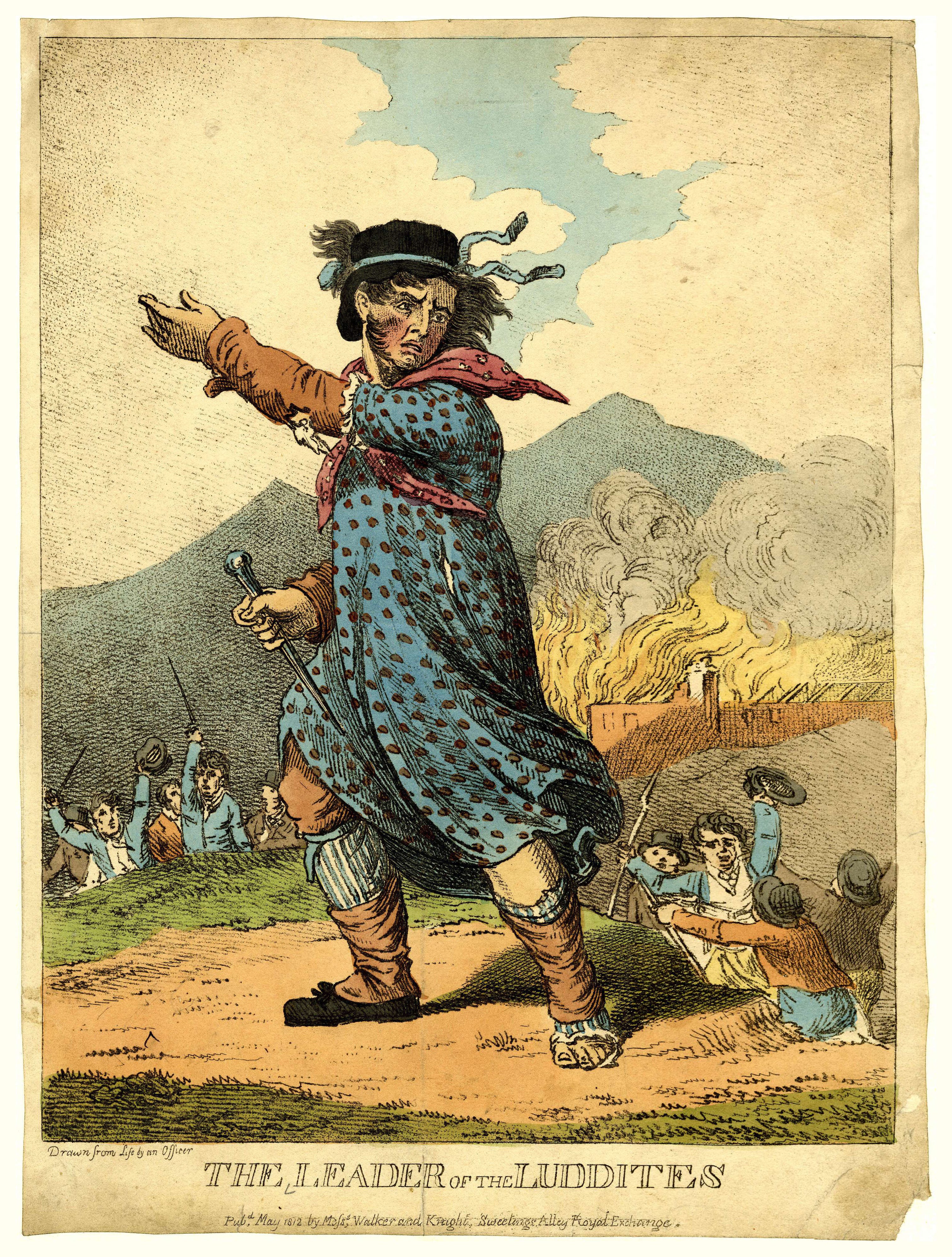
Ned Ludd, also called Captain, General or even King Ludd, first showed up in a Nottingham protest in November 1811. The story went that a young apprentice named Ludd or Ludham, scolded for knitting too loosely, grabbed a hammer and smashed his frame. It may never have happened. It didn’t matter. The workers had their general.
They had fun with it, too. They sent official-sounding letters signed from “Ned Lud’s Office, Sherwood Forest,” a nod to Robin Hood. Some marched in women’s clothes as “General Ludd’s wives.” In Yorkshire they called their big sledgehammers “Great Enoch,” after the local blacksmith who’d made both the hammers and many of the machines. Their saying was, “Enoch made them, Enoch shall break them.”
That’s good branding. It’s a big part of why we still use the name 200 years later.
The government’s answer: the gallows
The government didn’t hold hearings on wages or apprenticeships. It sent soldiers and passed a law with consequences that could include capital punishment.
The debate in the House of Lords is worth reading. The Earl of Liverpool argued that “the terror of the law” would work where lighter punishments hadn’t. Lord Holland summed up the government’s logic this way: “Whereas it has been found difficult to detect these offenders, we will render that detection still more difficult.”
Byron didn’t hold back. He asked: “Will that which could not be effected by your grenadiers, be accomplished by your executioners?” He described a starving worker “meagre with famine, sullen with despair, careless of a life which your lordships are perhaps about to value at something less than the price of a stocking-frame.”
The bill passed anyway. The Frame-Breaking Act passed Parliament and got royal assent on March 20, 1812. Breaking a stocking frame, or forcing your way in to try, became a felony punished by death. The law was written as temporary, set to run until March 1, 1814.
Then the government sent thousands of soldiers to guard the factories. Although the violence ran both ways, more of it fell on the workers. In April 1812, about 2,000 protesters mobbed a mill near Manchester. The owner’s men fired into the crowd, killing at least 3 and wounding 18. Soldiers killed at least 5 more the next day. That same month, two Luddites died attacking a mill in Yorkshire. Luddites later killed a mill owner.
Then came the trials. At a special court in York in January 1813, 64 people were tried. Seventeen men were hanged, including the three convicted of that murder, and others were transported to Australia.
How the name got flipped
The Luddites lost eventually. And, as we all know, the winners write the history. Or in this case, the meaning of the word.
Over time, “Luddite” stopped meaning a skilled worker fighting for fair pay. It came to mean someone afraid of anything new. The historian Edward Tenner put it well. He wrote that “the indignation of nineteenth-century producers” has given way to “the irritation of late-twentieth-century consumers.”
The AI lesson
Ravenser made a point in that same comment that I keep coming back to:
“The issue I see with LLM use is more the way in which it’s used than the usage per se.”
He’s right. That’s the Luddite lesson exactly. And he warned about what comes next:
“When LLMs are found to be efficient, cheap and tireless, and precise like 19th century manufacturing automation, and if “knowledge-heavy” roles in law, translation, coding, HR, etc., are outsourced to them, then we’ll probably be better placed to decide how much we’ve overreacted after human teams are “thinned out”.”
That’s a fair worry. It’s what the mill owners did in 1812. They used a machine to make worse goods with cheaper, untrained hands, and called it progress. And anyone that has tried to apply for a job in the last two years is painfully aware of just how bad computerized, AI based HR systems have become.
But I don’t think the answer is to fear the tool. As I told him: “Of course there are people that outsource their analysis and thinking to AI. But that is nothing new; they just went from outsourcing it to The Media or Politicians or Pundits or their neighbor, Joe, to the AI. Human nature doesn’t change.”
And it’s coming either way. As I put it: “But one thing is certain: it is coming whether we like it or not, just as the automobile replacing the horse and buggy was inevitable.”
So the real questions are the Luddites’ questions. Who’s using the tool? For what? And do skill and quality still count?
I’ve tried to live that. I let an AI write an essay and showed you what happened in Grok Wrote Me An Essay. And when AI detectors started flagging my own pre-AI writing, I explained Why I Turned Off AI Detection. If letting AI do our writing for us is bad, then conversely letting AI grade our writing is also bad. The detector panic punishes the skilled writer and lazy writer alike and really helps no one. Slop writing is slop writing, regardless of the source. It’s the frame breakers’ story turned around: blame the tool, and the person gets hurt.
Ravenser also brought up the movie Her. In it, he noted, “it’s personal human interaction which the human characters crave. So, not apocalyptic and we do still have choices.”
We do. Use the machine where it makes life better. Don’t hand it your judgment. And don’t blame the hammer for what the owner decided to do with it.
Ravenser closed with a dram of Ardbeg. I like Ardbeg too.
Light a cigar. Pour a dram. Enjoy. Relax.
Further Reading
Blood in the Machine by Brian Merchant (Little, Brown, 2023). The best modern telling, and it ties the Luddites straight to Big Tech.
Writings of the Luddites edited by Kevin Binfield (Johns Hopkins University Press, 2004). Their own letters and songs, in their own words.
The Making of the English Working Class by E.P. Thompson (first published 1963). The classic history that took the Luddites seriously.