


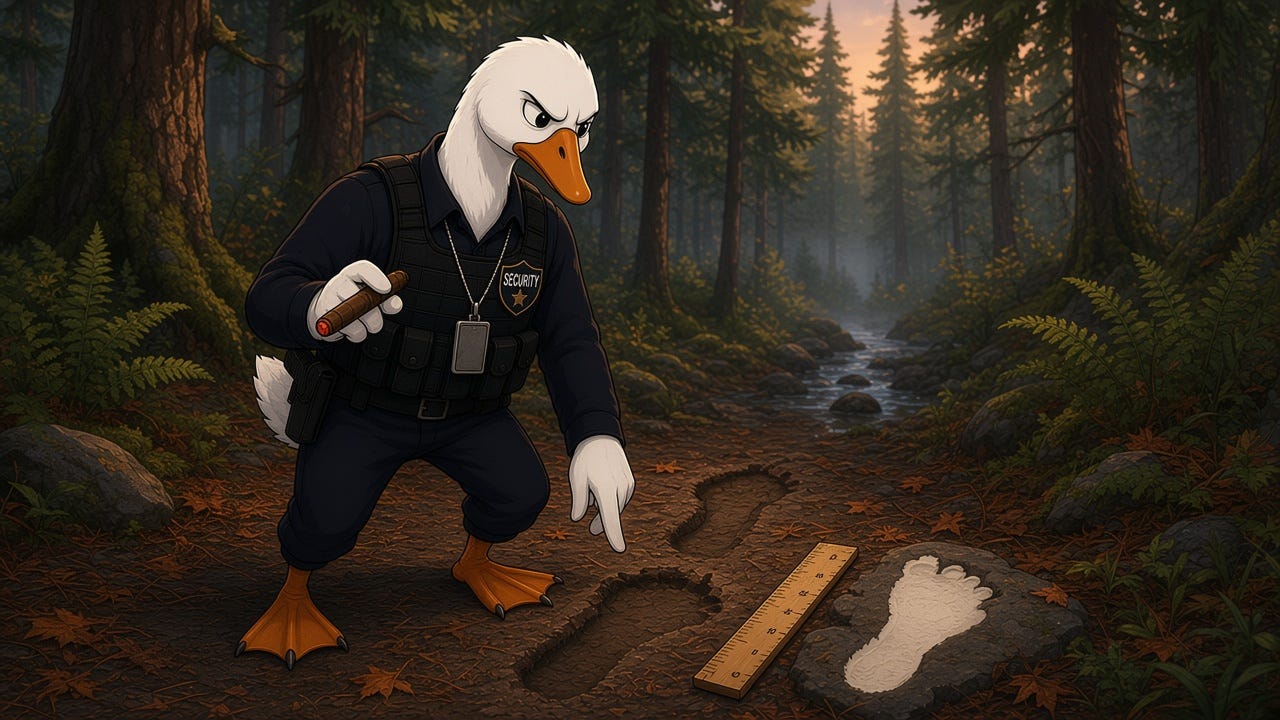
Honk. The U.S. Forest Service just put Bigfoot on official letterhead. Not a sighting. A file. Three records landed in the agency’s public FOIA Reading Room under the heading “Bigfoot/Sasquatch Records.”
I read this one with an Oliva Serie V and two fingers of rye, and I started with the only investigation in the stack that actually left the office.
June 18, 1982. Umatilla National Forest, letterhead from Pendleton, Oregon. Wildlife biologist Rodney L. Johnson writes up a trip into the Mill Creek watershed to look at reported “Bigfoot” tracks along Low Creek. The group hit two sites on June 17 and skipped a third. At the first, six identifiable tracks over about 25 feet, including a right foot about 15 inches long and 7 inches wide. They made plaster casts and took pictures. At the next site they found about 18 prints over 40 feet, and made more casts.
That’s a proper shift. You don’t close a case from a desk when the mud is still wet.
Johnson’s conclusion was plain. In his opinion, those tracks were “made by something other than a 300 pound plus two footed being.” He listed eight reasons. The stride stayed about four feet and did not change with the slope. The prints were shallower than the investigators’ own boots in the same mud. Some tracks looked isolated, not like a trail you could follow. Forest litter at one site looked brushed aside first, and some prints looked “rocked” from side to side.
Then the line that got logged: “If the tracks were faked, someone went to a great deal of trouble and detail.” The print marks, he wrote, would be very hard to duplicate and looked natural. He almost suspected a cast of an actual foot, though if that were the case the other creases should have shown.
A July 1982 memo in the same file is less patient. Joel Hardin, a U.S. Border Patrol tracker out of Bellingham, Washington, examined the sign and wrote that the tracks were “a very clever attempt to perpetrate a hoax.” He thought somebody had used a soft plaster or rubber coated foot. He closed with the sentence that ought to hang over every clipboard in the building: “Trusting that this memo will suffice to close this ‘Bigfoot’ case.”
The other two records aren’t investigations. They’re people telling you what they saw, or thought they saw. A 2003 clipping from the Clark Fork Valley Press describes hundreds of strange footprints reported near River Road West in Montana after a snowfall. One print was measured at about 16 and a half inches long, with an average stride of about five feet. Rain took most of them the next day. The paper noted there was no solid, conclusive evidence that Sasquatch exists.
Then there’s Leo T. Kinney’s history of Montana’s Petty Creek, written around 1980. He describes a 1949 trip with three others to pack out a six-point bull elk. They found only the entrails, and a large set of tracks in the snow. “At first we guessed it was a very large bear except bears don’t walk on their hind legs only for short distances.” Whatever it was, he wrote, had picked up the elk whole and clear of the ground. They followed about half a mile, to a three-foot log the thing had stepped over, with drag marks from the horns on top. Then, in his words, “we held a conference and decided that we were not particularly anxious to catch up to whatever it was.” Nobody in that party claimed an actual sighting. The next year, a hunter in the same country found similar tracks, smelled a strong odor, heard a grunt, and went looking for elk somewhere else.
Hand this stack to Lord Do Nothing and you already know the ending. He’d either stamp the memo “closed” without leaving the parking lot, or he’d appoint the Interagency Subcommittee on Unverified Bipedal Sign, send a note marked “just checking in,” and adjourn until the plaster casts crumbled. Either way, nobody walks the creek.
Here’s the difference between a file and a perimeter. A report is a start, not a confirmation. “I saw tracks” is not a credential. You go to the mud, measure what is there, and write down what you can prove, including the part that still bothers you. Johnson did that. Hardin did that, then closed the case. Kinney and his friends held a conference and chose not to catch up. None of that requires a creature on the masthead, or a pretense that the file isn’t there.
My gate’s locked. The cigar’s drawing clean. Tell me in the comments the oddest official report that ever landed on your desk, and whether you walked out to look.
Security n Cigars is free to read. Come through on two feet.
Signed, Gerald
Further Reading
US releases files on suspected Bigfoot sightings in Montana and Oregon (The Guardian, Nov. 22, 2026). How the Forest Service files surfaced, including Johnson’s investigation and Kinney’s Petty Creek account.
Freedom of Information Act (FOIA) Reading Room (U.S. Forest Service). The official listing, dated Oct. 15, 2026, under “Bigfoot/Sasquatch Records”: the June 18, 1982 Umatilla investigation, the 2003 Clark Fork Valley Press clipping, and Kinney’s Petty Creek history. The three PDFs are attached on that page.
The gate’s open and the reading’s free. Come through, and leave the unverified tracks in the file where they belong.