


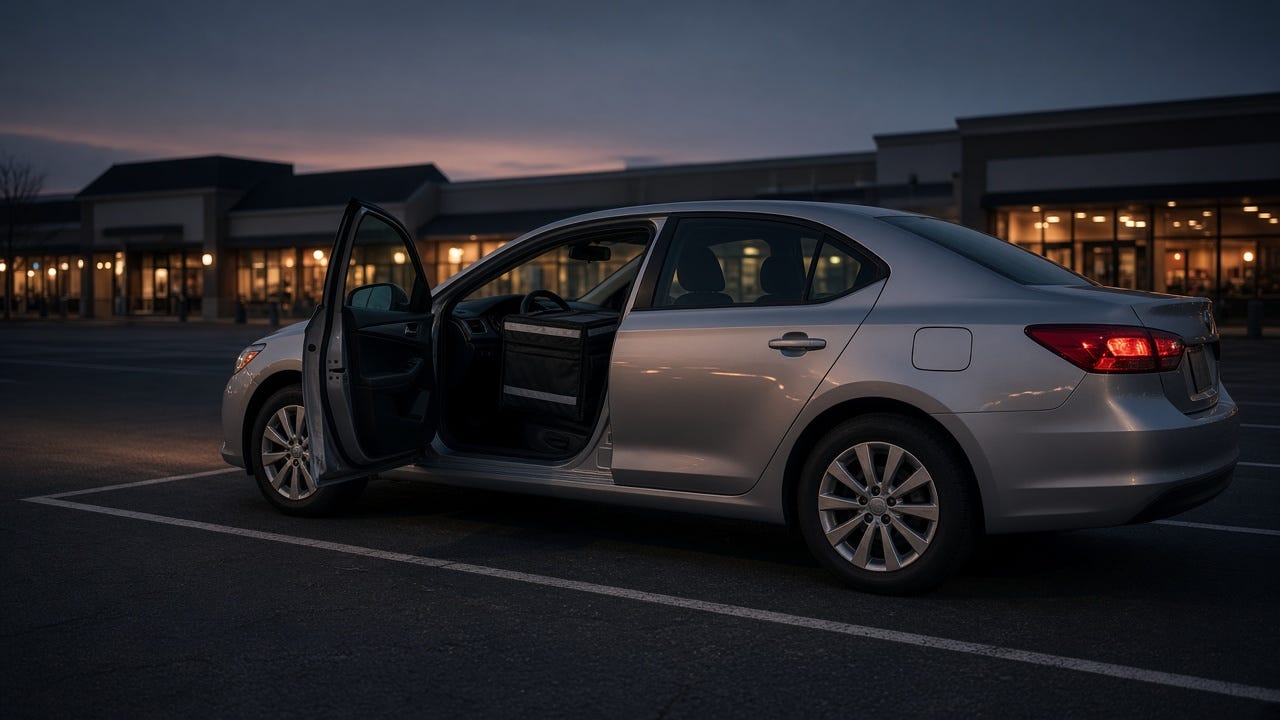
The headline making the rounds is some version of “DoorDasher shoots man in self-defense after parking lot attack” (WSB-TV). It reads like a parking-lot argument that turned into a shooting. It’s not. By the time the gun came out, the fight was already at arm’s length, because the door was already open.
This isn’t a verdict and it’s not a gear review. It’s what a carrier who spends hours a day seated and buckled into a car should take from it.
What happened
Here’s the sheriff’s account, and only the sheriff’s account, as reported by local outlets.
On Thursday, October 8, around 5:35 PM Eastern, Tyler J. Reese, 26, of Augusta, a DoorDash driver, was at the West Town Shopping Center on Washington Road in Martinez, Georgia, in front of Cho Ba Mien Asian Market and Formosas (The Augusta Press, WRDW). Benjamin Robert Dasher, 29, of Evans, approached him. Witnesses told deputies Dasher was acting erratically and was significantly larger than Reese. The Augusta Press reports a family member had already noticed erratic behavior and dropped him off at the Walmart on Bobby Jones Expressway (The Augusta Press).
Dasher demanded Reese “buy me a 20 piece.” Reese said no and got shoved. He pushed Dasher away and went inside for his order.
Around 5:38 PM Reese was back in the driver’s seat. Dasher repeated the demand, said he would take the vehicle, and opened the front passenger door. Reese displayed his firearm and said he didn’t want any more trouble.
Dasher said he would take the gun too. He went around the car and lunged through the open driver’s door, attacking Reese while he was still seated. Reese fired three times. Three hits, left arm and abdomen. The gun was a .40-caliber Glock 27, per Maj. Andy Shedd of the Columbia County Sheriff’s Office. I mention the model because it’s a fact in the record. I don’t care about the brand, and neither should you.
Deputies have surveillance video with no audio, witness interviews, and a processed scene. As of the latest reporting, Reese hasn’t been charged and the sheriff’s preliminary self-defense finding stands. Dasher was last reported in the ICU, expected to survive, and is to be charged with criminal attempt to hijack a motor vehicle once he’s released.
Lesson 1: The fight is at arm’s length
You’ve heard of the 21-foot rule. Sgt. Dennis Tueller of the Salt Lake City Police Department wrote “How Close Is Too Close?” for SWAT magazine in March 1983. His drills showed an attacker can cover about 21 feet in the 1.5 to 2 seconds it takes to draw and fire (Police Magazine).
Tueller himself says it’s not a rule. He prefers “reactionary gap” and calls it “a sliding scale… all based on reaction and response time.” His warning is the part that matters: “if you hesitate, your assailant can be on top of you before you even draw” (The Marshall Project). Some later studies put the distance closer to 31 feet.
Now put that in a car. There’s no 21 feet. There’s no 31 feet. An open door puts the threat at zero to three feet. You’re seated. You can’t step back. You can’t move off line. Your reactionary gap is gone before anything starts.
So the work happens before the door opens. Doors locked while you’re working. Engine running. A decision made in advance that when someone escalates, you leave. Shooting Illustrated puts it first for a reason: “If you can drive away, do so” (Shooting Illustrated). I’m not second-guessing Reese. Nothing reported tells us whether driving away was an option for him. I’m telling you what to set up in your own car.
Lesson 2: Showing the gun isn’t a force field
Reese did what a lot of people think ends things. He showed the gun and said he didn’t want any more trouble. It didn’t end it. The man announced he would take the gun too and came through the door.
Tueller has had confrontations where drawing and challenging ended it without a shot. For most people, in many situations, showing the gun does end it. The ones where it doesn’t are the ones we hear about, and that’s where you have to be prepared for things to escalate. Showing the gun isn’t a plan for when it doesn’t work.
If you show it, you’ve already decided what happens if the other person keeps coming. Kyle Lamb says it well: “make as many hard decisions as possible now, before trouble finds you” (Guns & Ammo). Make them in your driveway, not at the curb.
And understand what someone lunging through a door means. He’s close enough to grab. That’s a retention problem, not a marksmanship problem.
A short legal note, because I’m not a lawyer and won’t pretend to be. O.C.G.A. § 16-3-21 is Georgia’s law on the use of force in self-defense, and it has two steps. You’re justified in threatening force when you reasonably believe it’s necessary to defend against imminent unlawful force. Deadly force requires a reasonable belief that it’s necessary to prevent death, great bodily injury, or a forcible felony. And the aggressor loses that justification. Threat and use are different steps with different standards. The conclusion here belongs to investigators.
Lesson 3: Seated draws, seatbelts, and reps
Here’s the problem nobody practices. Seated and buckled, a right-handed hip carrier finds the seat belt hardware sitting right on top of the pistol. A threat from the driver’s side forces the muzzle across your own body (Shooting Illustrated).
There are two schools, and both are valid. Kyle Lamb, carrying appendix, draws first and releases the belt after. SGM Craig “Chili” Palmer releases the belt first and draws after. Lamb’s answer: “You have to figure out what works for you.”
Here’s how you figure it out. Lamb put a shot timer on it and found he was faster drawing with the belt still on, for his appendix setup. Same thing I said in Under a Second. Time it. Don’t guess.
A few details that matter:
Use the support hand to clear the belt. Don’t swap the gun between hands.
Shooting Illustrated describes routing the belt around the outside of the wheel so the muzzle never crosses your body.
Seated means exposed. Plan how you get out and get behind the vehicle.
The drill: your own car, in your garage or driveway, dry fire or airsoft, as Lamb suggests. Unloaded gun, all ammunition in another room. Buckle in. Wear the clothes you actually wear. Put a timer on it.
Winter changes the math
I said this last week: “winter coming, and heavy duty clothes, also means I get to carry in leather …. gunfighter time!” I meant it. But a heavy coat changes the seated draw. It bunches up against the seat back and covers the belt buckle. Lamb again: “Don’t let your clothing impede getting to the gun quickly.”
Re-run the seated draw with your winter coat on before the first cold morning, not after.
Same principle, different body position
In Under a Second Is Not a Personality Trait, the Orland Park customer was standing at a pump, hand staged, with a fast first shot. Martinez was seated, buckled in, with the threat inside arm’s length. Same principle in both: reps you paid for in advance. Different body position, different reps. If all your dry fire is standing in your living room, you haven’t trained for either fight. You’ve trained to shoot a Post-it note in your living room.
A caveat. The sheriff’s office calls its self-defense finding preliminary: “Based on the evidence obtained to this point.” Per WRDW, there are no charges against Reese “right now… pending the conclusion of the investigation.” Dasher hasn’t been interviewed and his charge hasn’t been filed. This piece draws training lessons from the public account. It’s not a ruling on anyone’s guilt.
The gun didn’t open the door, and it didn’t close it. The reps did.
Get in your car this week, buckle up, and time it. Then do it again.
Further Reading
Will the “21-Foot” Defense Work for the Chicago Cop Who Shot Laquan McDonald? by Beth Schwartzapfel (The Marshall Project, 2015). Tueller explains the reactionary gap in his own words.
Drawing Your Pistol While Seatbelted in a Vehicle: Click It by Kyle Lamb (Guns & Ammo, 2021). Belt first or gun first, settled with a timer.
How to Defend Yourself Inside of a Vehicle by Dick Williams (Shooting Illustrated, 2017). Drive away first, then the mechanics if you can’t.
O.C.G.A. § 16-3-21 (Georgia Code, via Justia). Read the statute yourself instead of the comment section.
Modern Minuteman
Practical preparedness for everyday citizens.
Low-profile. Reliable. Quiet competence.
#Minuteman #EDC #Training #Preparedness #Mindset