


If you watch the evening news or scroll through political social media, you’ve likely been conditioned to believe in a simple, mechanical equation: more guns in a society must inevitably equal more murder. It sounds entirely intuitive. If you increase the supply of a dangerous object, you should expect to see a linear increase in its lethal misuse.
But if you step away from the talking heads and map thirty years of hard data onto a canvas, that intuitive equation completely shatters.
Take a look at the data. If raw firearm availability were the primary dial controlling America’s homicide rate, the line tracking gun ownership and the line tracking murders would be locked in a deadly, parallel dance.
Instead, when we adjust for population to look at the true per capita metrics, they look like they belong to two completely different countries.
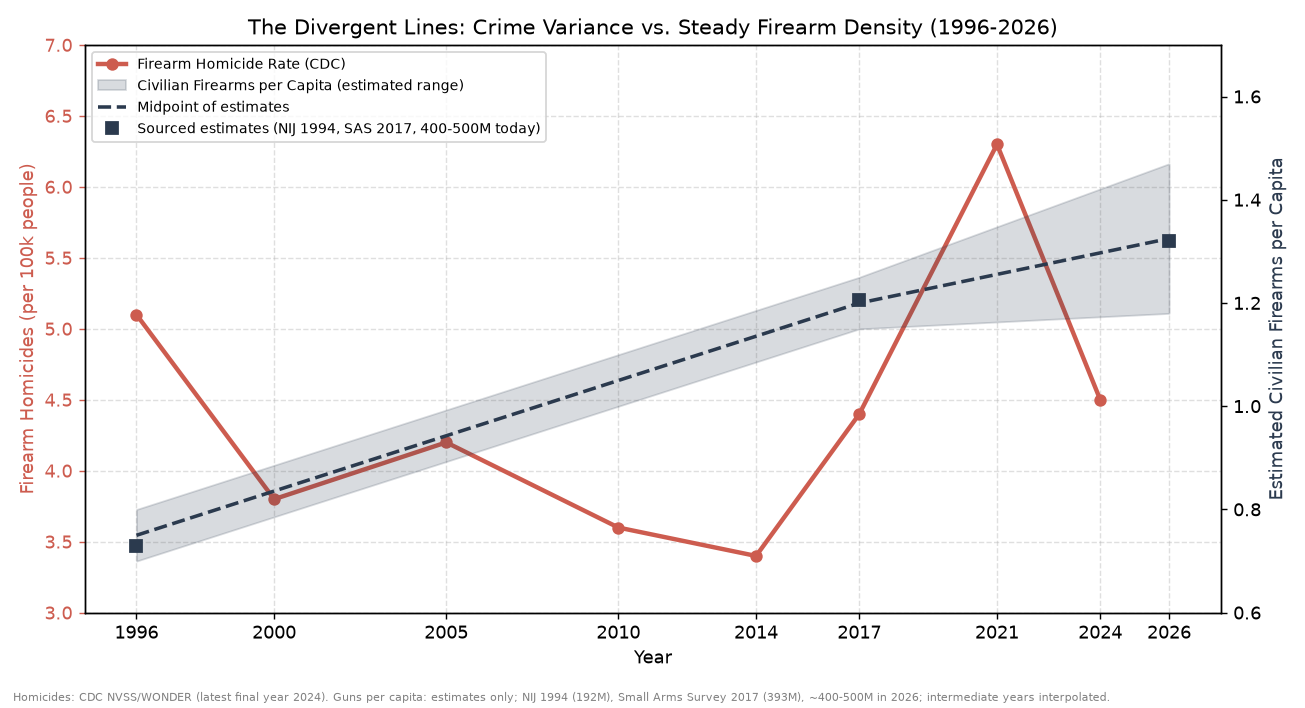
Since 1996, the line tracking civilian firearms per capita in the United States has been a smooth, predictable staircase, climbing relentlessly year after year. Nobody actually knows how many guns Americans own. Every count is an estimate. A 1994 National Institute of Justice survey put the civilian stock at about 192 million, roughly 0.73 firearms per person; by 2026, estimates run from roughly 400 to 500 million guns (the Small Arms Survey counted about 393 million in 2017), or somewhere around 1.2 to 1.5 firearms per capita, an increase of roughly 60–100%. [NIJ, Small Arms Survey]
Here’s what that looks like from my own gun safe. Firearms are durable goods. Nobody ever throws one away. And until the Gun Control Act of 1968 required serial numbers on newly manufactured guns, there was no federal requirement to serialize or track them at all. Two pistols in my safe can’t be accounted for in any centralized way: a 1950s Ruger .22 LR pistol I got from my father-in-law, and a Walther made in Germany in 1938 that came home from WWII as a war trophy and passed through several hands before landing with me a few years ago. Its serial number tells me its history, but no record anywhere shows that it still exists, that it’s in the US, or that I’m the one who has it. I’m just one guy. But these are durable guns that don’t get counted and don’t get thrown away.
The line tracking the firearm homicide rate, however, is a volatile, unpredictable roller coaster. It plunged to historic lows during the late 90s and 2000s, hit a jagged bump after 9/11, dropped to a 30-year low of 3.4 per 100,000 in 2014, skyrocketed into a terrifying peak of 6.3 during the height of the COVID-19 pandemic, and then experienced one of the fastest drops in modern history, down to 4.5 in 2024, the latest final CDC figure. [CDC]
Mathematically and visually, the disconnect is glaring: Americans owned far more guns per person in 2026 than they did during the peak of the 2021 crime wave, yet the murder rate plummeted anyway.
The Twin Illusions of the Gun Debate
This dramatic divergence forces us to confront a reality that both sides of our polarized political landscape routinely ignore. Partisan pundits, whether wearing red or blue ties, are locked in the exact same analytical trap: they treat the firearm as an independent variable possessing near-magical properties.
To the anti-gun advocate, the weapon is a viral pathogen that spontaneously generates violence merely by existing. If guns are present, blood must flow. The data explicitly refutes this.
But the chart refuses to cooperate with the mainstream pro-gun fantasy either. For decades, gun rights advocates have championed the inverse equation popularized in the late 1990s: More Guns, Less Crime. The theory goes that a heavily armed populace acts as a universal deterrent, a polite society engineered by the omnipresent threat of mutual self-defense.
Yet between 2014 and 2021, Americans bought firearms at an unprecedented, record-breaking pace, driving civilian gun density to its highest level in human history. If the deterrence theory held water, this massive civilian mobilization should have frozen violent crime in its tracks. Instead, the country watched in horror as the firearm homicide rate spiked by nearly 40% in just two years (2019 to 2021). Furthermore, public health surveys show that this surge in gun volume didn’t represent a massive wave of new households arming themselves for defense; it primarily reflected existing enthusiasts expanding their personal collections. A firearm locked in a suburban safe does nothing to alter the criminal calculus on a city block miles away.
Both sides are entirely obsessed with the object. And by focusing exclusively on the tool, both sides completely ignore the actual, underlying architecture of human violence.
A Return to Foundational Principles
To be clear, pointing out that “more guns don’t mathematically equal less crime” isn’t an indictment of gun ownership. Rather, it liberates the defense of the Second Amendment from a battlefield of moving goalposts, social engineering, and bad statistics.
I am deeply pro-gun, but not because I believe a statistical fairy tale that a gun in every holster automatically creates a peaceful utopia. I am pro-gun for the exact same reasons the American Founders were.
The authors of the Constitution did not draft the Second Amendment because they were amateur criminologists trying to optimize urban homicide metrics. They didn’t look at the right to bear arms as a public policy lever designed to manage street-level theft on the frontier. They viewed it through the lens of political architecture and fundamental human rights.
To figures like James Madison, George Mason, and Thomas Jefferson, an armed populace was a structural check against tyranny, a baseline insurance policy for a free state, and a recognition of the inherent, natural law right to individual self-preservation. They accepted, as a matter of course, that freedom carries inherent risks and that bad actors would always misuse the tools of liberty. But they believed that disarming the virtuous to disarm the vicious was a fundamental betrayal of a free society.
When modern gun rights advocates tie their defense exclusively to utilitarian promises of crime reduction, they are fighting on the wrong terrain. A firearm is an inert tool. It multiplies human intent, but it does not create it.
The dial controlling the American murder rate isn’t wired into the gun factory; it is wired into entirely different societal machinery. To understand why violence rises and falls, we have to stop staring at the metal and start looking at the environment.
Section II: The Three Eras of Illusion and Reality
To truly understand how disconnected the murder rate is from the raw supply of firearms, we have to stop looking at thirty years of history as a monolith. Instead, we must zoom in on three distinct historical eras. When you dissect these periods, the superficial talking points of both political tribes evaporate, leaving behind a much more interesting story about human behavior, institutions, and social stress.
Era 1, The False Negative: The Federal Assault Weapons Ban (1994–2004)
For the political left, the decade between 1994 and 2004 is frequently cited as the gold standard of proof that gun control works. In 1994, Congress passed the Federal Assault Weapons Ban (FAWB), halting the manufacture and sale of certain semi-automatic rifles and high-capacity magazines. Superficially, the baseline narrative writes itself: the ban was enacted, and over the next ten years, the American murder rate steadily and beautifully plummeted. [1, 2, 3]
But a look at what was actually happening on the ground completely upends this neat causation.
First, the law contained a massive grandfather clause. Millions of existing semi-automatic rifles remained legally in circulation. Second, because of loopholes in the legislation, domestic manufacturers simply made slight cosmetic modifications to their designs, such as removing bayonet lugs or flash suppressors, and kept churning out semi-automatic rifles by the hundreds of thousands. In fact, gun ownership and the overall volume of semi-automatic rifles in civilian hands grew during the ban. [1, 2, 3]
If the sheer existence of these weapons drove the murder rate, homicides should have stayed flat or risen. Instead, they cratered. Why? Because the 1990s was an era of profound institutional realignment. It was the era of massive economic expansion, the winding down of the crack-cocaine epidemic that had destabilized urban markets, a massive influx of local police funding, and the introduction of data-driven policing models like CompStat. The crime decline happened because the underlying societal drivers of violence were being actively suppressed, not because a manufacturing restriction magically changed criminal intent.
Era 2, The Institutional Vacuum: The Post-9/11 Ripple (2000–2005)
If the 1990s showed that crime could drop while gun volume grew, the first half of the 2000s proved that crime could rise without any sudden change in gun patterns. Between 2000 and 2005, the smooth upward trajectory of per capita gun density didn’t stutter. It kept climbing steadily. Yet, the firearm homicide rate experienced a sudden, troubling reversal, breaking the great 1990s decline and creeping up from 3.8 to about 4.2 per 100,000 residents.
To find the culprit, you have to look entirely outside the firearms market and look at a nation in shock.
The morning of September 11, 2001, fundamentally reorganized American law enforcement overnight. Federal resources from agencies like the FBI were instantly diverted away from local violent crime task forces, gang intervention units, and street-level drug enforcement to focus entirely on counterterrorism and domestic intelligence. At the same time, local police departments faced massive strains: their budgets were stretched thin to secure critical infrastructure like airports and transit hubs, and many of their officers were military reservists suddenly deployed overseas to fight the Global War on Terror (GWOT).
Combined with the economic friction of the 2001 dot-com recession, this created a massive “policing and institutional vacuum” in major metropolitan areas. Proactive, community-level safety frameworks collapsed, local drug markets fractured, and localized turf wars in cities like Detroit, New Orleans, and Baltimore surged. The tools of violence hadn’t changed; the institutional structures keeping the peace had.
Era 3, The Ultimate Disconnection: The Pandemic Shock and Collapse (2019–2026)
The ultimate proof of concept, however, belongs to our most recent history. The period between 2019 and 2026 will go down in criminological history as the definitive case study in why gun density is an independent variable.
In 2020 alone, the United States experienced a historic, terrifying 29% explosion in its homicide rate, the largest single-year jump recorded in modern history. Simultaneously, firearm sales smashed every historical record. To the anti-gun lobby, this was cause-and-effect in its purest form: panic-buying flooded the streets with steel, and blood inevitably followed. To the “More Guns, Less Crime” lobby, this was a massive failure of deterrence theory; millions of new guns failed to stop the slaughter. [1]
But then came the twist.
By the second half of 2022, the homicide rate began to tick down. In 2024, the decline accelerated. By 2025, the U.S. murder rate experienced an astonishing 18.1% single-year drop, the largest one-year decrease on record, plummeting to 4.1 per 100,000 residents. By 2026, the national homicide rate had officially tied historic lows last seen in the mid-1950s, with early 2026 data showing the drop continuing at a blistering pace. [1, 2, 3, 4, 5, 6, 7, 8]
And what did civilian firearm density do during this historic, unprecedented drop in murder? It kept climbing to an all-time high. By most estimates, there is now well over one gun for every American.
If guns cause crime, the 2024–2026 collapse in homicides is statistically impossible. If guns deter crime, the 2020–2021 spike is statistically impossible. The data forces us to look at the actual reality: the pandemic spike was caused by severe social trauma—the total disruption of the economy, the closure of courts, schools, and community violence intervention networks, acute mental health crises, and massive civil unrest that caused police departments to retreat into reactive posturing. The historic drop that followed occurred because local economies stabilized, communities rebuilt their safety nets, and local law enforcement re-engaged with focused deterrence strategies. [1, 2]
The guns remained entirely constant in their steady, linear accumulation. The humans using them did not.
Section III: The Ghost Market and the Three Real Pillars
If the macro numbers prove that a massive influx of legal firearms doesn’t automatically trigger a spike in homicides, it forces us to ask a critical question: Where are crime guns actually coming from, and who is using them?
This is the second major analytical blind spot of the modern debate. When activists and politicians push for new restrictions, they talk as if the typical perpetrator of a violent crime is a law-abiding citizen who walks into a local gun shop, passes a federal background check, and then goes out to commit a murder.
The data reveals that this scenario is a statistical myth.
According to data compiled by the Bureau of Justice Statistics (BJS) Survey of Prison Inmates, the overwhelming majority of firearms used in violent crimes are handguns, not rifles, and they are possessed illegally. In fact, the BJS reports that only about 1 in 10 prisoners who had a gun during their offense obtained it from a legal retail source (like a gun shop, pawn shop, or gun show). [1, 2]
The other 90% got their gun outside legal retail channels, through a thriving, underground shadow economy and informal networks: [1]
Theft (6%): Firearms stolen from legal owners during home burglaries or vehicle break-ins.
The Underground Street Market (43%): Weapons trafficked illegally by gang networks and criminal enterprises.
Family and Friends (25%): Guns obtained from a family member or friend, or received as a gift. [1, 2]
Found at the Scene (7%): Guns picked up at the scene of the crime. (Source: BJS, Survey of Prison Inmates, 2016)
The reality is that citizens who buy guns legally, pass rigorous background checks, and respect the law are vanishingly rare participants in violent crime. Law-abiding gun owners are not the problem. Instead, violent crime is heavily concentrated among a small population of chronic offenders operating entirely outside the legal system, using illegally obtained pistols. [1, 2]
Therefore, if legal firearm density isn’t moving the needle on the murder rate, what is? Criminologists and economists point to Three Real Pillars: the environmental dials that actually dictate the rise and fall of American violence.
Pillar 1: Social Stability and the Fabric of Trust
The sharpest fluctuations in violent crime, like the drop in the 1990s or the pandemic spike, reflect changes in the social fabric, not the gun supply. When community trust in law enforcement collapses, localized violence surges. If people in high-crime neighborhoods believe the justice system is illegitimate or incapable of protecting them, they stop cooperating with investigations and increasingly turn to street-level, retaliatory violence to resolve conflicts. Furthermore, when local community safety nets (like youth outreach, mentorship programs, and mental health networks) are disrupted, interpersonal volatility immediately fills the void.
Pillar 2: Economic Disinvestment and Concentrated Poverty
Decades of geographic data demonstrate that violent crime is not evenly distributed across the population. It is intensely localized within specific neighborhoods characterized by systemic economic distress. Localized economic shocks (such as factory closures, hyper-inflation, or sudden lockdowns) disrupt local economies and drive individuals into high-risk underground street markets. When local economies hollow out, municipal tax bases shrink, forcing cities to cut funding for the exact community development, infrastructure, and social programs that keep violence at bay.
Pillar 3: Tactical Policing and Judicial Efficacy
The strategic framework of local law enforcement plays a massive role in shifting the risk-reward calculus of violent actors. A police department’s homicide clearance rate, its ability to catch and successfully prosecute shooters, is one of the single most powerful deterrents to violent crime. When clearance rates drop, a vacuum of accountability forms, fueling cycles of retaliatory street violence. Conversely, when cities implement targeted, proactive, and data-driven strategies, such as Focused Deterrence (focusing resources specifically on known violent repeat offenders) and Community Violence Intervention, homicides plummet, even while regional gun ownership continues to climb.
Conclusion: Treating the Disease, Not the Symptom
When we look closely at the last thirty years of American history, the lesson is clear. The fierce political focus on the firearm itself is a massive, bipartisan distraction. In fact, over the last few years, our country managed to radically and historically reduce the murder rate. Yet we are completely ignoring how we actually did it. Instead of studying the localized policing turnarounds and community interventions that successfully brought us back to near-record lows, we continue to engage in an ideological sideshow over gun control aimed squarely at law-abiding citizens.
Treating the firearm as a magical object, whether as a pathogen or a protective talisman, allows policymakers to avoid doing the hard, expensive work of fixing broken systems. Passing restrictions on law-abiding citizens does absolutely nothing to disrupt the shadow market of stolen handguns used by chronic offenders.
Conversely, chanting “More Guns, Less Crime” does nothing to heal an urban block suffering from extreme economic neglect or a collapse in community policing.
The American Founders left us with a system of political architecture that protects the inherent right of the individual to bear arms for self-preservation. They understood that a free society requires trusting the virtuous citizen. The data shows that the Founders’ trust was well-placed; legal gun owners are not driving the American homicide rate.
If we genuinely want to keep violence down in America, we have to stop staring at the metal. We must focus our attention and our resources exactly where the fire is burning: by stabilizing localized economies, rebuilding trust in our justice systems, and aggressively targeting the small contingent of violent, illegal actors who actually pull the triggers.
Further Reading
More Guns, Less Crime: Understanding Crime and Gun Control Laws (3rd ed.) by John R. Lott Jr. (University of Chicago Press, 2010). The data-heavy case for right-to-carry deterrence, the argument this piece says the pro-gun side leans on too hard. Read it and judge for yourself.
Uneasy Peace: The Great Crime Decline, the Renewal of City Life, and the Next War on Violence by Patrick Sharkey (W. W. Norton, 2018). A sociologist’s look at how the great crime decline remade American cities, and what it takes to keep violence down.
Unforgiving Places: The Unexpected Origins of American Gun Violence by Jens Ludwig (University of Chicago Press, 2025). The head of UChicago’s Crime Lab argues that most shootings grow out of arguments, not calculation, which makes them more preventable than either side assumes.