

In 1863, Lincoln asked a country still fighting to give thanks, and to pray for the people the war had already broken.
The year was not gentle. Lincoln still asked the country to notice “the blessings of fruitful fields and healthful skies,” and to pray for the widows, the orphans, and the Union.
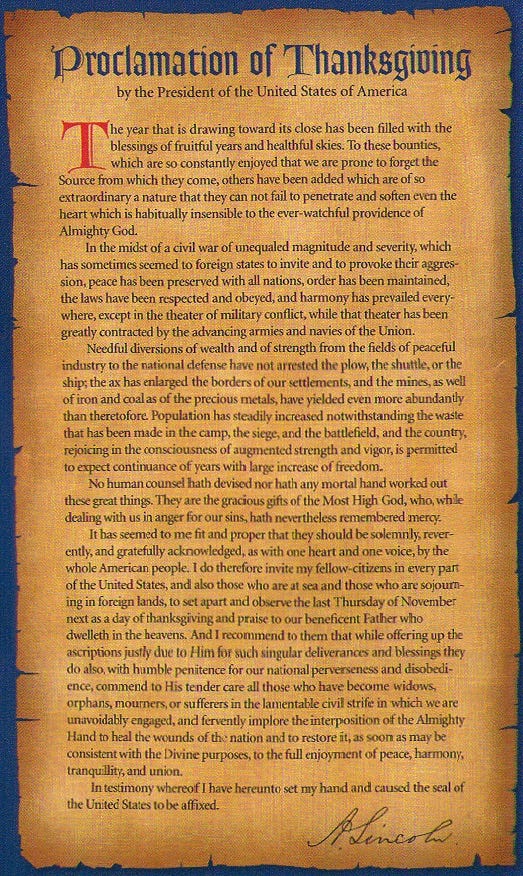
On October 3, 1863, in the middle of the Civil War, Abraham Lincoln issued a proclamation inviting the country to set apart “the last Thursday of November next, as a day of Thanksgiving and Praise.” That Thursday was November 26. A week earlier he had spoken at the new cemetery at Gettysburg. The war was not over. He asked the country to give thanks anyway.
This was not the first Thanksgiving in America, and it was not even Lincoln’s first thanksgiving proclamation that year. On July 15 he had already set apart August 6 as a day of national thanksgiving, praise, and prayer after recent victories on land and sea. The October proclamation was doing something more lasting. It named a regular national day, on the same Thursday in November, for the whole country.
Seventy-four years earlier, also on October 3, George Washington had issued the first presidential thanksgiving proclamation under the Constitution. States and churches had long set their own days, often at different times. What Lincoln was being asked to do in 1863 was to fix one day for the Union.
Five days before the proclamation, Sarah Josepha Hale wrote to him from Philadelphia. She was the longtime editor of Godey’s Lady’s Book, and she had been pushing the idea for years. “For the last fifteen years,” she told Lincoln, “I have set forth this idea in the ‘Lady’s Book.’” She wanted “the day of our annual Thanksgiving made a National and fixed Union Festival,” held “on the same day, in all the States.” In her words, it needed
National recognition and authoritive fixation, only, to become permanently, an American custom and institution.
“Authoritive” is her spelling, and I am leaving it as she wrote it. She asked him to appoint the last Thursday in November, which, she noted, “falls this year on the 26th.”
I am not going to claim that one letter, by itself, produced the proclamation. Hale also wrote to Secretary of State William H. Seward and asked him to take the matter up with Lincoln. She had been sending the same argument to governors for years. What we can say is this: her letter is in Lincoln’s papers, the date is five days before the proclamation, and the day she asked for is the day he named.
The proclamation went out over Lincoln’s name and the seal of the United States. His secretary John Nicolay later wrote that the manuscript was “written by Seward and is in his handwriting.” That is worth knowing, and it does not change the official act. The President issued it. The country was being asked to do something hard.
He did not begin with the battlefield. He began with the harvest:
The year that is drawing towards its close, has been filled with the blessings of fruitful fields and healthful skies.
Then he told the truth about the year those fields had grown in:
In the midst of a civil war of unequalled magnitude and severity, which has sometimes seemed to foreign States to invite and to provoke their aggression, peace has been preserved with all nations, order has been maintained, the laws have been respected and obeyed, and harmony has prevailed everywhere except in the theatre of military conflict; while that theatre has been greatly contracted by the advancing armies and navies of the Union.
He was not pretending the war was over, or that it had been cheap. Later in the same proclamation he wrote of “the waste that has been made in the camp, the siege and the battle-field.” He also refused to let the waste be the only fact of the year. The plough, the shuttle or the ship had not been arrested. Mines were still yielding. The country, he said, could still expect “continuance of years with large increase of freedom.”
That is a serious kind of gratitude. It does not require you to call a hard year a soft one. It requires you to notice what has not been destroyed, and to remember who you think is responsible for it.
No human counsel hath devised nor hath any mortal hand worked out these great things. They are the gracious gifts of the Most High God, who, while dealing with us in anger for our sins, hath nevertheless remembered mercy.
Then came the invitation, not only to people at home, but to “those who are at sea and those who are sojourning in foreign lands.” And then the part that makes this a wartime Thanksgiving, and not just a harvest notice:
And I recommend to them that while offering up the ascriptions justly due to Him for such singular deliverances and blessings, they do also, with humble penitence for our national perverseness and disobedience, commend to His tender care all those who have become widows, orphans, mourners or sufferers in the lamentable civil strife in which we are unavoidably engaged, and fervently implore the interposition of the Almighty Hand to heal the wounds of the nation and to restore it as soon as may be consistent with the Divine purposes to the full enjoyment of peace, harmony, tranquillity and Union.
Lincoln’s charge to America was to give thanks, Tell the truth about the cost, and take care of the people the war has already broken. And finally to ask that the nation be healed and the Union restored.
I have sat down to more than one meal in a hard year. In 1990, I gave thanks with my fellow soldiers in the midst of the Saudi Arabian desert, knowing that we would cross the Line of Departure sometime in the next few months. I have been gone from home on Thanksgiving a dozen times while in the Army. We still gave thanks, even if it was different. You can pass the food and still tell the truth about what is missing. That is not false cheer. It is grown-up gratitude. The people who most deserve to be remembered at the table are often the ones who are not there.
Lincoln did not ask the country to take a day off from reality. He asked it to see the blessings and the wounds in the same light, and to pray for both. The last Thursday of November, 1863, was still a day in a war. He asked a country still fighting to sit down anyway, and not to forget the widows and the wounded while it gave thanks.
That is a serious Thanksgiving. It still is.
Further Reading
Proclamation of Thanksgiving, October 3, 1863 at House Divided. The text is adapted from Roy P. Basler’s Collected Works of Abraham Lincoln, volume 6, with the original spelling preserved.
Sarah J. Hale to Abraham Lincoln, September 28, 1863 in the Abraham Lincoln Papers at the Library of Congress. The letter in which Hale asked the President to fix the last Thursday in November as a national Thanksgiving.