


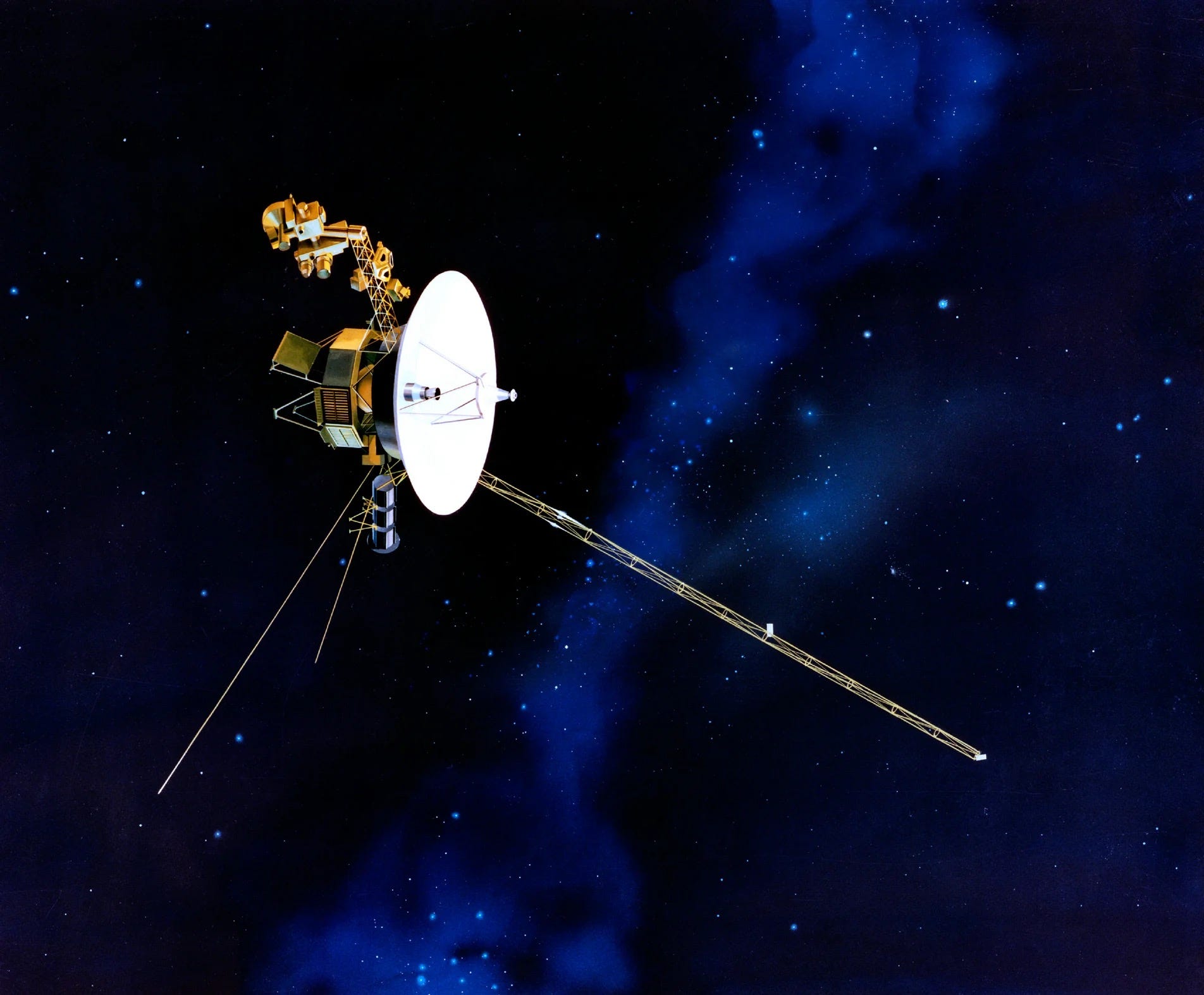
Twelve hours ago, at 2:16 a.m. Pacific Time, Voyager 1 reached one light-day from Earth.
That’s 16.094 billion miles. A light-day is a measure of distance, not time. It’s how far light travels in 24 hours. A radio call sent at that moment takes a full day to reach the spacecraft, and another full day to get home. Nothing we have ever built has been this far away.
From a light-day away, Earth is a blue and green ball. Americans, Russians, and Iranians aren’t perceptible. Neither is anyone else. It’s a little planet circling a minor sun in a spiral arm of the galaxy.
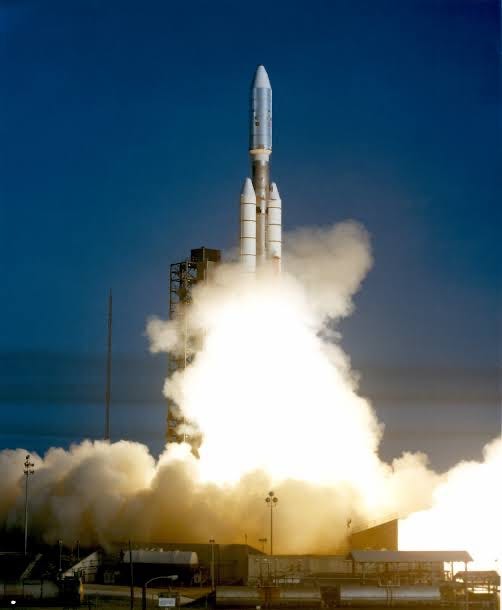
Sunlight needs only about eight minutes to get here from the Sun. A signal from Mars can take a few minutes or a little over 20, depending on the day. Voyager 1 is a whole day out. It has been flying toward that mark since September 5, 1977. Its twin, Voyager 2, launched 16 days earlier and took a longer road, past Uranus and Neptune. NASA says that one is on pace to reach a light-day from Earth in November 2035. Today’s mark belongs to Voyager 1.
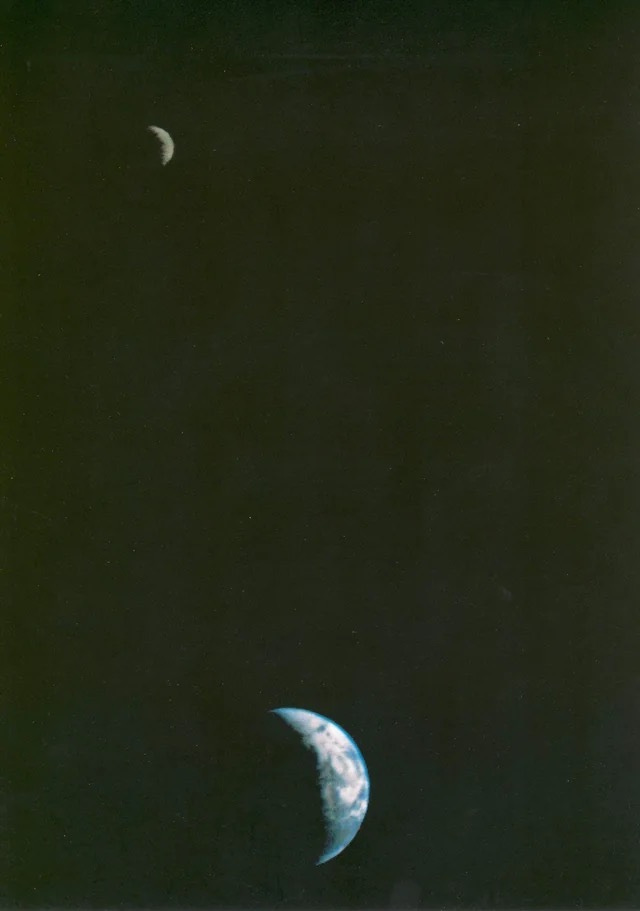
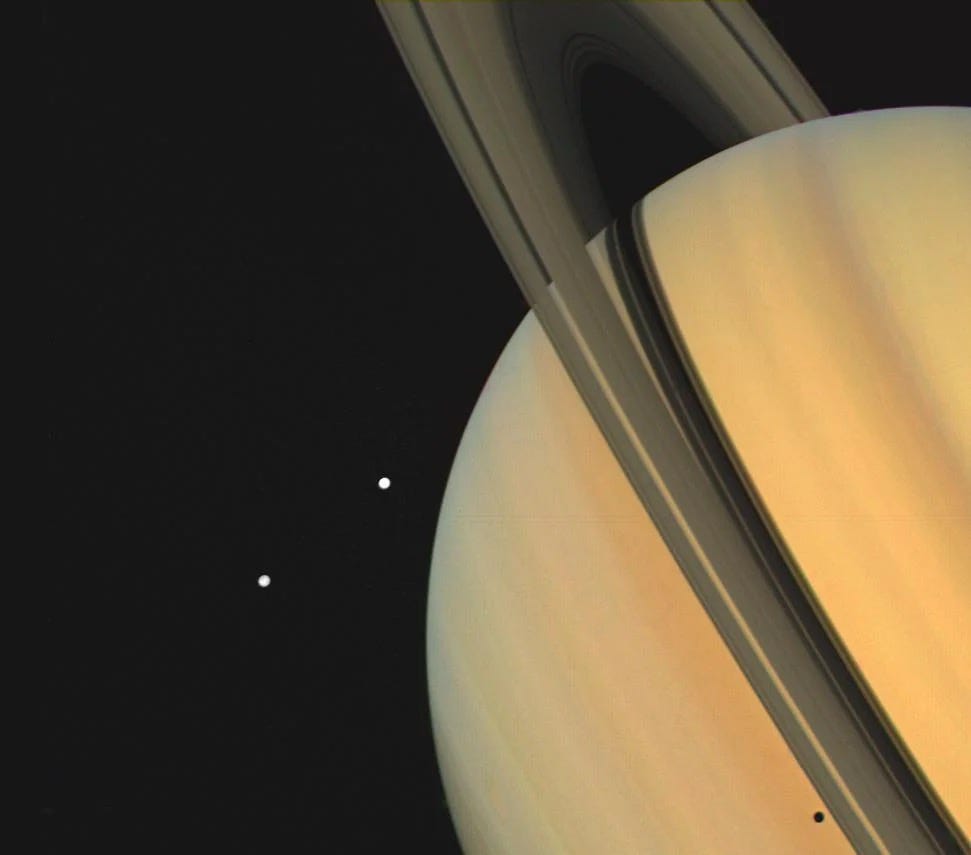
We got a preview of the view back when the spacecraft was much closer than it is today. On February 14, 1990, at a distance of 3.7 billion miles from the Sun, the team had it turn its cameras around for one last look. It snapped a series of frames that became the first family portrait of the solar system. In the picture that became known as the Pale Blue Dot, Earth was a fraction of a pixel, a faint point caught in a scattered ray of sunlight. Then they turned the cameras off for good.
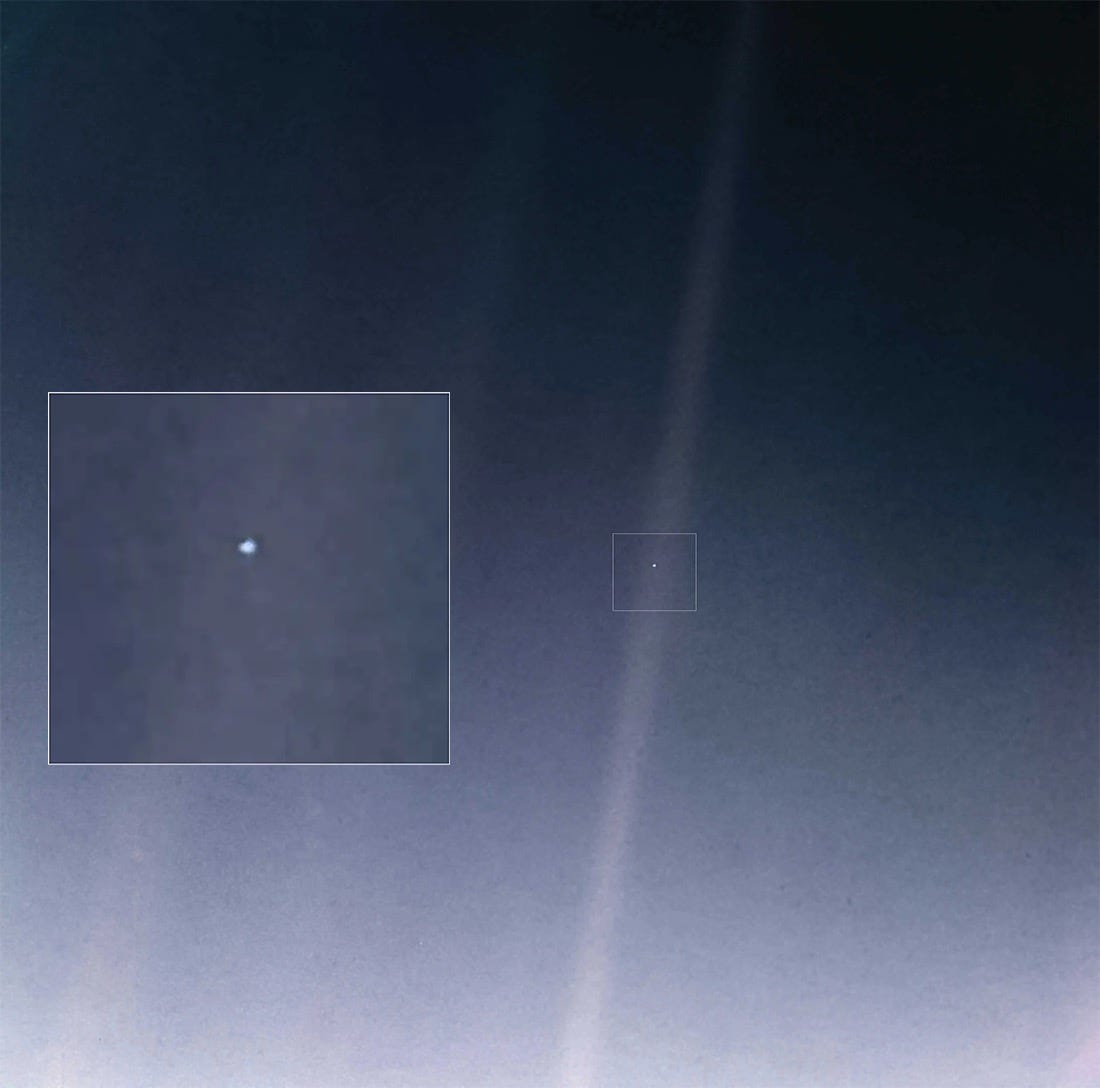
Carl Sagan wrote about that image in his 1994 book, Pale Blue Dot. The people on that pixel, he wrote, “lived there—on a mote of dust suspended in a sunbeam.”
It took Voyager 1 49 years, two months, and 11 days to get from the pad to today’s mark. A lot has come and gone down here in that time.
Jimmy Carter was president when it launched. Seven other people have held the office since. Presidents have come and gone. So have the arguments that felt so large at the time.
The Berlin Wall opened in November 1989. Germany reunified the next year. In December 1991 the Soviet Union was dissolved, and 15 independent countries stood where one union had been. Czechoslovakia became two countries. Yugoslavia came apart over the years that followed. New states appeared on the map, including Eritrea, Timor-Leste, and South Sudan. A greeting recorded for the Golden Record speaks of 147 United Nations member states. There are 193 now.
Wars have been fought and receded. The Soviet war in Afghanistan. The war between Iran and Iraq. The Falklands. The Gulf War. The wars that broke up Yugoslavia. Afghanistan and Iraq again. Ukraine. I could keep going. That’s not the point.
All of that happened on the same small world. From a light-day out, none of the lines we draw are visible. The factions aren’t visible either. Humanity is still here.
I was 11 when Voyager launched. Apollo wasn’t ancient history then. It had been only eight years since men walked on the Moon and left a plaque fastened to a leg of the lunar module, where it still sits. The plaque reads:
HERE MEN FROM THE PLANET EARTH
FIRST SET FOOT UPON THE MOON
JULY 1969 A.D.
WE CAME IN PEACE FOR ALL MANKIND
Back then, “for all mankind” wasn’t a slogan. It was how we felt.
American engineers at JPL built this spacecraft, and Americans paid for it, and I’m proud of that. Each Voyager also carries a Golden Record, a gold-plated disc with pictures, music, the sounds of Earth, and greetings in 55 languages. It went from all of us on Earth, a message in case anyone ever finds it. Any other intelligence that encounters that record won’t know anything about Americans. It will only know that another intelligent race was able to achieve this, and that we tried to say hello.
Some days we need to rise above the petty and look at things on that scale. Almost 50 years later, I still feel the same way I did at 11.
Voyager is one of the high points of human engineering, and America is the country that pulled it off on behalf of everybody. Both things are true.
The spacecraft is still going. Engineers have been turning instruments off one by one to save power as the generators slowly fade. The cameras have been dark since that last look in 1990. Two instruments are still running, a magnetometer and a plasma wave instrument, sending back data from interstellar space, which Voyager 1 entered in August 2012. NASA says there’s enough power to keep at least one science instrument going into the 2030s. We may still be able to reach it through about 2036.
After that it will go on in silence, still carrying the record, still headed out into the dark. It will be about 40,000 years before it makes a close approach to any other planetary system. The record goes with it anyway.
I think about that 11-year-old sometimes. He couldn’t have pictured 49 years of flight, or a radio call that takes a day to arrive. He didn’t need the numbers. He just knew we had sent something out there, and that it was for all of us. The feeling is the same one I had then. It’s a little planet around a minor sun. It’s still home.
Further Reading
Voyager 1: What Is a Light-Day (NASA Science)
Voyager 1’s Pale Blue Dot (NASA Science)