


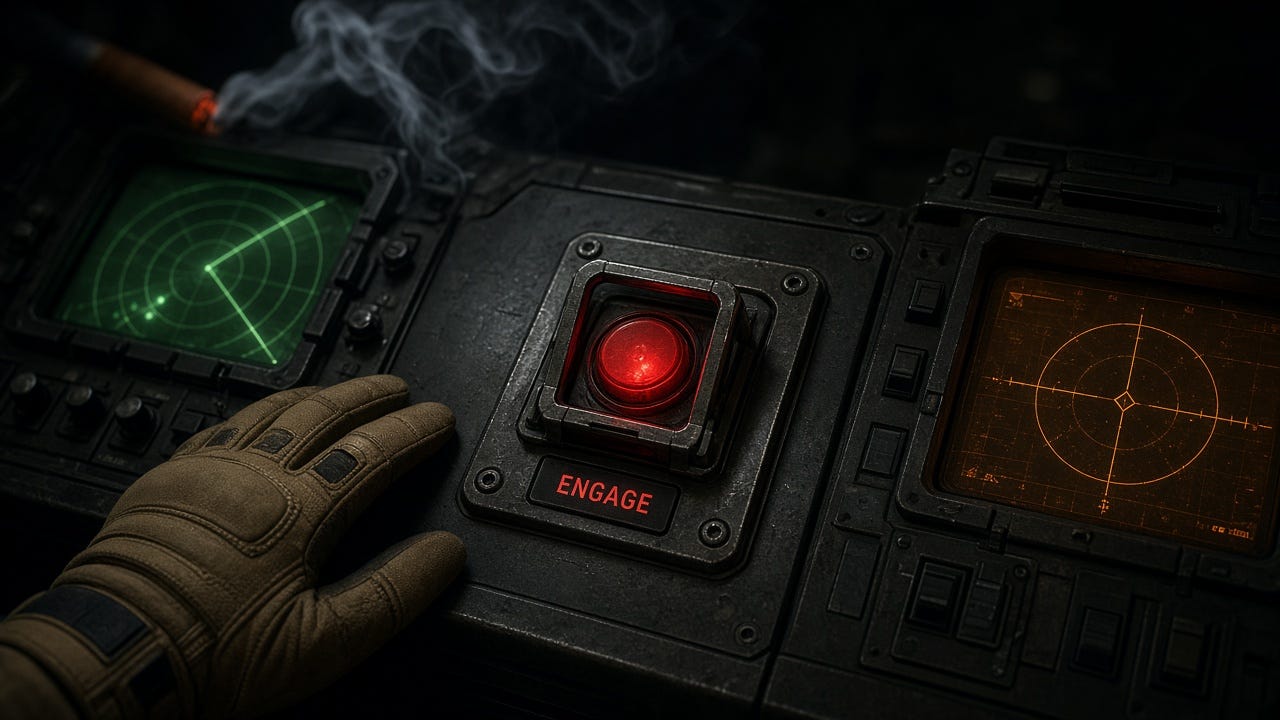
When I came up in the Army, the kill chain moved at the speed of people. Somebody saw something and reported it. A staff officer checked it against the map and the rules of engagement. A commander made the call, somebody pulled a trigger, and somebody else checked whether it worked. It took minutes on a good day and hours on a bad one. But every step had a person on it, and every person had a name.
The fastest version of that I know is a tank crew. The tank commander spots a target and calls the fire command. The gunner lays on it and calls “Identified.” The loader seats the round and calls “Up.” The commander says “Fire,” and the gunner sends it: “On the way.” A good crew goes from first sighting to a round downrange in under ten seconds. In gunnery training, a crew might get three targets at once, say a tank, a BMP, and a squad of troops, and has to kill all three in under twenty seconds to max the score. That’s about as fast as a 100 percent human engagement gets. Four soldiers, every shot a human decision, one commander who owns it.
That decision-making and those physical actions, hitting three targets under twenty seconds, are pretty much at the outer edge of what humans can do. To get it faster, the weapon systems have to be computer controlled. That’s the bridge from a tank crew to hypersonic missiles and drone swarms: past that edge, autonomy isn’t a philosophy paper. It’s the only way the shot still lands.
Now the hard question. How much faster do things have to go to deal with a hypersonic missile that maneuvers on the way in, a drone swarm coming from every direction, or a missile that has to be killed in the few minutes it’s climbing on its engines? In some of those fights, ten seconds is an eternity. Autonomous weapons, hypersonics, and weapons in orbit are all squeezing that clock. Different technologies, same question: who’s in charge, the computer or the warrior?
The kill chain, in plain English
The kill chain is just the sequence for hitting a target: find, fix, track, target, engage, assess. The side that runs it faster usually wins.
Put a computer in that chain and there are three ways to set it up:
Human in the loop. The machine finds and recommends, but a person has to say “yes” before anything fires. The human is a required step.
Human on the loop. The machine finds, decides, and fires, and a person watches with a hand on the off switch. The human is a supervisor, not a step.
Human out of the loop. The machine does it all.
None of this is new. The Navy has had a human on the loop since the 1980s. Aegis is the combat system on many Navy ships that watches the sky and sea for incoming aircraft and missiles, then can fire the ship’s own missiles to kill them. Think of it as the ship’s anti-air and missile-defense brain. It went to sea in 1983, and the ship’s commander can switch on its most automatic setting. Once he does, Aegis fires on threats that meet its parameters without anybody authorizing each shot. A sailor can still stop it, but nobody has to say “fire.” Same logic as the Phalanx gun on the deck: a sailor can’t react as fast as an incoming missile.
Here’s the part most people miss. “Human in the loop” isn’t actually Pentagon policy. The governing rule, DoD Directive 3000.09, requires “appropriate levels of human judgment over the use of force.” Michael Horowitz, whose office wrote the 2023 version, has said plainly that the directive has no human-in-the-loop requirement, on purpose. The standard is accountable human judgment, not a person pressing a button every time. The one hard line is nuclear weapons, where U.S. policy keeps a human in the loop.
That’s not crazy, and Aegis proves it. But it means the whole question rides on one word: appropriate. Appropriate to whom, decided when, and checked by whom?
You can hear how slippery it gets. In a report from Fort Bragg, NPR watched an autonomous gun on a pickup shoot down drones in seconds. A soldier running the demo said, “There’s a human on the loop to decide whether to engage the target.” On, not in. For swatting drones, that might be exactly right.
Hypersonics and orbit: the clock gets shorter
Hypersonic weapons fly at five times the speed of sound or more, and the newer ones maneuver in flight, so they’re hard to track and hard to predict. The Congressional Research Service notes that Russia and China have likely fielded hypersonic glide vehicles, and it flags the problem directly: weapons this fast and this maneuverable leave the defender less time to decide.
Space is the extreme case. The Space Force’s Space-Based Interceptor program for Golden Dome would put interceptors in low Earth orbit to hit missiles in their boost, midcourse, and glide phases. Space Systems Command says tracking and interceptors “must be integrated with Artificial Intelligence to counter the speed, maneuverability, and lethality of the threats.”
Gen. Michael Guetlein, who runs Golden Dome, has been honest about where that leads. Command and control can be “100% human-in-the-loop” in peacetime, he’s said, but “as the threat accelerates,” there’s “more and more automation,” per The Space Review. The author asks the right follow-up: who decides when to make that shift?
Nobody wants to be the general who lost a carrier waiting on a phone call. A staff meeting doesn’t fit in a boost-phase window. So the human sets the rules ahead of time, and the machine executes.
In the air: the fighter as quarterback
The Air Force and Navy are building the same thing into airpower: a fighter quarterbacking a handful of drone wingmen the services call Collaborative Combat Aircraft. In a test this spring, an F-35 pilot used a cockpit tablet to send a drone orders to maneuver and change coordinates, and the drone’s own autonomy software worked out how. The Navy has had F-35 pilots controlling multiple drones from tablets in its simulators.
Think about the OODA loop: observe, orient, decide, act. A fighter pilot’s already running one for himself at hundreds of miles an hour. Now he’s supposed to run it for several more aircraft, at the speed the fight demands. He can’t. So he calls the play, and the computers are presumably making most of the decisions inside it. That isn’t science fiction. It’s the math of the cockpit.
That’s the real shift across all of these. The human decision moves from the moment of firing to the moment of writing the rules. That can be done responsibly, but only if the rule writers know what they’re doing and somebody’s checking their work.
Judgment: the target list
Paul Scharre, who helped draft the Pentagon’s first autonomous weapons policy, told NPR where it drifts. A human might authorize “a target list of a whole bunch of targets, but the human doesn’t really have time to, like, pore through each one individually.” Technically there’s a human involved. Practically, he’s a rubber stamp.
It isn’t theoretical anymore. NPR reported that the Maven Smart System, the AI tool that helps find and identify targets, worked at ten times the previous speed in the first hours of the Iran War, according to analysts at CSIS. Glenn Reynolds wrote in March that much of the campaign’s success depends on advanced technology, “including, apparently, extensive use of AI in targeting and damage assessment.” In April, in what he called “purest speculation,” he guessed AI was also doing planning that used to take hundreds of staffers, while noting the Pentagon and Israeli Air Force have said they use AI to identify and track targets.
That’s reasonable evidence, not proof. Reynolds added a warning worth taping to every ops center wall: you can bet the Chinese are already working on ways to “penetrate and subvert our AI systems.” A faster kill chain is a real advantage. It also leaves a lot less time for the person checking the machine’s work.
Building the command, leaving the desks empty
So who’s checking?
On Sept. 30, Secretary Hegseth signed a memo creating Project Agincourt, the pathway to a new four-star Autonomous Warfare Command, AUTOWARCOM, with a target date of Oct. 1, 2027. It’d be a functional command, like Special Operations Command, owning drones and autonomy everywhere instead of a chunk of the map.
An Oct. 21 open letter from the project’s leaders has a line I like: “Urgency does not excuse imprecision.” Hegseth says the department plans to field “hundreds of thousands” of one-way attack drones this year and millions in coming years.
Now the other side of the ledger. The office that oversees responsible use of AI had filled three of its ten authorized positions as of February, according to a GAO report covered by Military Times. Twenty-nine of the 64 tasks in its own Responsible AI plan were still incomplete in April. Its working council went months without meeting and still doesn’t have a charter.
Three of ten. In my world, a critical section at 30 percent strength isn’t “stretched.” It’s not mission capable.
The money isn’t locked either. Defense One reports the $54 billion request is riding on a reconciliation bill, and in light of the midterm election outcome, the defense bill is highly unlikely to get done this year. Retired Maj. Gen. John Ferrari put it bluntly: “Buying it is the easy part. Using it is the hard part.” Using it well means trained operators, tested systems, clear rules, and a named human who answers for the result.
Congress is at least asking. The Senate Armed Services Committee’s version of the defense bill would write 3000.09 into law, with requirements for supervision, ways to intervene or shut a system down, records of targeting logic, and a flat ban on AI deciding to launch a nuclear weapon. The House version is lighter, and both still have to survive conference. A rewrite of 3000.09 itself has also been ordered. Sen. Mark Kelly put the core question plainly: does a human make the final call, or can the system engage on its own? “These are questions we haven’t yet dealt with.”
The rest of the world’s asking too. The UN’s Convention on Certain Conventional Weapons review conference, which takes up autonomous weapons, opens tomorrow.
Who owns the decision
I’m not against autonomy. I’d rather a robot gun shoot down a drone than a nineteen-year-old take the hit. Speed is a weapon, and if the other side has it and we don’t, people we love die.
But I took an oath, and I’ve written before about what that oath actually binds you to. It doesn’t bind a machine. A machine can’t be court-martialed. It can’t stand in front of a widow. It can’t refuse an unlawful order. The tank commander who says “Fire” owns that round. So does the Aegis captain who turns the system on. The moral weight of killing has always sat on a human being with a name and a rank, and our whole professional ethic is built on that.
The founders understood that armed force has to answer to someone. That’s civilian control: the people with the guns answer to the people’s representatives, through a chain of command that ends in a person you can hold accountable. Swap that person for an algorithm and you’ve changed who’s responsible, and in a republic, that’s the whole game. As I said in The Lincoln Deployment, reality doesn’t care about the press release. Somebody still has to own the outcome.
So here’s the real question, and it isn’t technical. When we move the human decision from the trigger to the rulebook, do we staff, train, and fund the rulebook like it matters? Or do we build a four-star command for the machines while the oversight desks sit empty?
Warriors either still own the moral decision, or they don’t. That choice is being made right now, mostly by budget lines and empty billets instead of anybody saying it out loud. I’d rather we say it out loud.
Further Reading
Autonomous Weapon Systems: No Human-in-the-Loop Required, and Other Myths Dispelled by Michael C. Horowitz (War on the Rocks, 2025). The guy who wrote the policy, explaining what it actually says.
Hypersonic Weapons: Background and Issues for Congress by the Congressional Research Service (R45811). The plain-English primer on why speed changes the decision.
Sensor-to-Shooter Is a Decision, Not a Wire (The Space Review, 2026). Who gets to flip the switch from human to automatic.
Naval War College paper on Aegis autonomy (Naval War College International Law Studies).
DoD Directive 3000.09 on autonomy in weapon systems (DoD, Jan 25, 2023).
NPR report from Fort Bragg on autonomous weapons (NPR, Oct 26, 2026).
Space Force Space-Based Interceptor program announcement (Space Systems Command).
F-35 controls General Atomics Avenger CCA autonomy test (Air & Space Forces Magazine, May 2026).
F-35 pilots and Navy CCA in Joint Simulation Environment (NAVAIR).
Don’t Drone Me, Bro! (Instapundit / Glenn Reynolds, Mar 19, 2026).
The Iran Operation (Instapundit / Glenn Reynolds, Apr 5, 2026).
Project Agincourt pathway memo (DoD, Sept 30, 2026).
Project Agincourt open letter (War.gov, Oct 21, 2026).
Hegseth on Autonomous Warfare Command (War.gov).
Pentagon AI oversight office struggles, GAO finds (Military Times, Oct 21, 2026).
Funding for Hegseth autonomous command (Defense One, Oct 25, 2026).
US Senate panel approves AI autonomous weapons rules (Arms Control Association, Jul/Aug 2026).
Security n Cigars is reader-supported. Subscribe to get new posts and support the work.
That is an excellent and timely piece. I track the Ukraine War daily and am watching AI each day take over more and more of warfighting. I agree that someone's rank and name tag should be attached to every act that involves the taking of human life, regardless of whether the green light is given early or late in the process. Some will argue that this might slow the process, but that has always been the price in war; some act boldly, and some do not, and both are expected to be held responsible for the outcome.
Jeff
I'm not seeing any humans in the loop owning responsibility for error at this point. That will presumably further decrease for humans on the loop. May as well just make it autonomous if no one is held accountable for mistakes.