

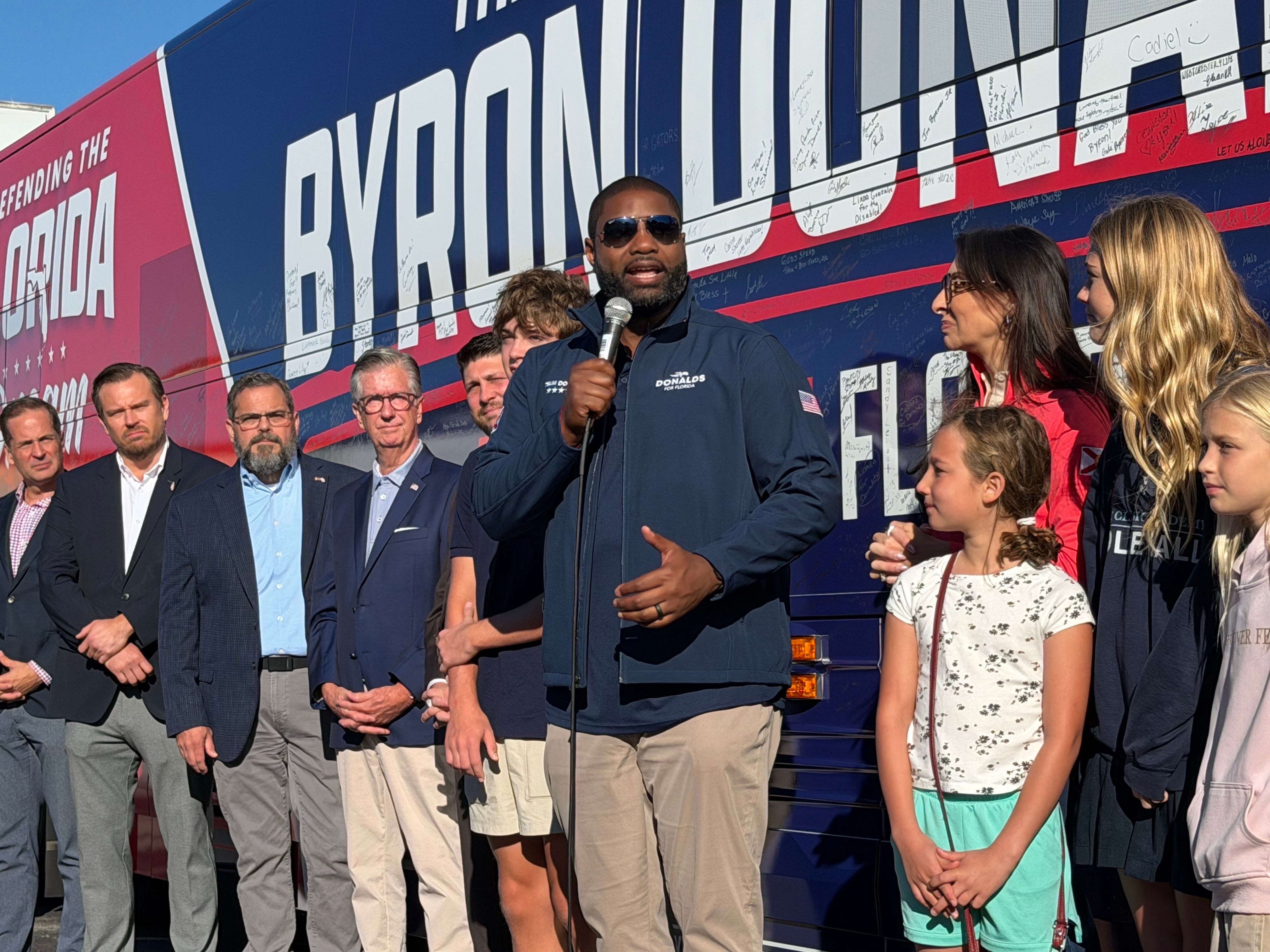
Byron Donalds won the Florida governor's race. The Florida Division of Elections has him at 4,135,701 votes, 50.01 percent, to David Jolly's 4,029,461, or 48.72 percent. The margin is 106,240 votes, about 1.3 points. Those figures are the Division's latest canvass as of November 13. They are not yet certified. The Elections Canvassing Commission is scheduled to certify the official returns on November 17.
Jolly conceded. The Associated Press called the race. Donalds will be Florida's first Black governor, and the first Black Republican elected governor in American history. A Black Republican, P.B.S. Pinchback, did serve as acting governor of Louisiana for about a month during Reconstruction, after being elevated from lieutenant governor. He was not elected to that office. Donalds was.
I can already hear the noise machine treating this as a one-day story, or as a partisan score. I want to talk about the state that just did it.
What Florida used to be
In January 1923, a White mob destroyed the Black town of Rosewood in Levy County. The houses were burned. The people who lived there fled, and many never went back. No one was convicted. Seventy-one years later, the state finally passed a compensation law for the survivors and their families.
In 1949, four Black men in Lake County, later known as the Groveland Four, were accused of raping a White woman. Ernest Thomas was killed by a posse. Samuel Shepherd was shot dead by the sheriff while being transported. Walter Irvin was shot and survived. Charles Greenlee went to prison. It took until January 11, 2019, for Governor Ron DeSantis and the Executive Clemency Board to grant them full posthumous pardons, and until November 22, 2021, for a court to formally exonerate them.
In June 1964, in St. Augustine, Martin Luther King Jr. was arrested after trying to eat at the Monson Motor Lodge. A week later, demonstrators went into the motel pool in an integrated swim-in. The manager, James Brock, poured muriatic acid into the water. That is hydrochloric acid, the same kind used to clean concrete. He poured it into a pool with people in it, in the oldest city in the United States, the same month Congress was finishing the Civil Rights Act.
This was not a few ugly episodes on the edge of an otherwise gentle state. The Equal Justice Initiative, in the third edition of Lynching in America, counted 311 African American lynching victims in Florida between 1877 and 1950. By population, Florida's rate was the second-highest in the South.
And then there is Jackie Robinson.
The ballplayer, and the tanker
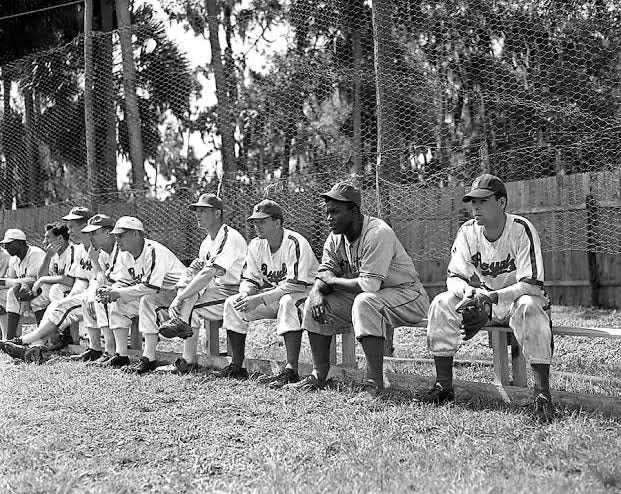
In 1946, Branch Rickey sent Robinson to Florida for spring training with the Montreal Royals, the Brooklyn Dodgers' top farm club. Daytona Beach was supposed to be the safer stop, in part because of Mary McLeod Bethune and a Black community that had some standing in the town. Even there, the seating was Jim Crow.
Sanford was worse. After about two days of practice, a White man told Black journalists that roughly a hundred townspeople would act if Robinson and his teammate Johnny Wright were not out of town by nightfall. They went back to Daytona Beach and trained at a field in the Black section of town. Jacksonville locked him out of the ballpark. DeLand cancelled a game. At a later exhibition, Sanford's police chief ordered Robinson off the field.
On March 17, 1946, at City Island Ballpark in Daytona Beach, Robinson played his first exhibition as a Royal against the Dodgers. The crowd was more than 4,000, about a quarter of it Black, sitting in a segregated section. That ballpark is now Jackie Robinson Ballpark. The state that named a field after him had spent that spring telling him where he was allowed to exist.
I have a personal reason this sits with me. Before he was a Royal, Jackie Robinson was a second lieutenant and a tanker.
He was commissioned in 1943 and assigned to the 761st Tank Battalion, the Black Panthers, at Camp Hood, Texas. On July 6, 1944, while he was on limited duty for an old ankle injury, a civilian bus driver ordered him to the back of an Army-contract bus. Robinson refused. War Department policy had already desegregated military buses. The argument turned into charges.
His battalion commander, Lt. Col. Paul L. Bates, refused to sign them. Robinson was transferred to the 758th Tank Battalion, whose commander did. The National Archives later noted that the paperwork to move him to the 758th was already in motion the week before the bus incident. The transfer is still what allowed the charges to be signed. He was tried by general court-martial on August 2, 1944, and acquitted. He never shipped to Europe with the 761st. He was honorably discharged in November 1944, about the time that battalion was going into heavy fighting.
I served in the 64th Armor Regiment. Our official lineage, the one the Army actually recognizes, runs through the 758th Tank Battalion, the Army's first Black tank battalion. It was redesignated the 64th Heavy Tank Battalion on November 3, 1949, and later became 64th Armor. The famous 761st is a sister battalion, not our parent. Robinson served in one and was transferred to the other, so his story touches both. Jackie Robinson is part of our regimental history, and we are proud of it.
Two years after that court-martial, Florida ran him out of Sanford for trying to play baseball.
What changed, and what didn't
Donalds is a Brooklyn kid, raised by a single mother. He came to Florida for college, finished at Florida State with a degree in finance and marketing, worked in banking, served in the Florida House, and then in Congress from the Naples area. That is not a fairy tale, and it is not the point. The point is that the voters of this state chose him.
The race was close. Close elections are still elections. A 1.3-point win does not make Florida a different country from the one that burned Rosewood, or framed the Groveland Four, or poured acid in a motel pool. It also does not make the result smaller than it is.
I am not going to pretend a governor's race erases any of that history. It doesn't. What it does show is that a state is not frozen in its worst chapters. The Florida of 1923, 1946, 1949, and 1964 did those things. The Florida of 2026 elected a Black man governor, in a statewide vote, under his own name, and it was not a Reconstruction appointment and it was not a gesture. It was an election.
That is the part worth sitting with. Not the spin. Not the claim that the work is finished. Just this: a place can change, and sometimes it does.
Light a cigar. Look at the map. Remember what it used to look like.
Further Reading
Florida Election Watch: Governor, Florida Division of Elections. The official state canvass of the 2026 governor's race. As of November 13 these returns were not yet certified; the Elections Canvassing Commission is scheduled to certify on November 17.
The Court-Martial of Jackie Robinson, by John Vernon, Prologue (National Archives, 2008). The documentary record of Robinson's 1944 court-martial, the 761st, and the transfer to the 758th.
Security n Cigars is reader-supported. Subscribe to get new posts and support the work.