


About 26 million Americans own a rifle that ten states, the District of Columbia, and a few cities and counties say they shouldn’t have. In December, the Supreme Court will hear two of those bans, from Cook County and Connecticut. The Second Amendment isn’t the thing on trial. The bans are. The Court already wrote the test in Heller and sharpened it in Caetano, Bruen, and Wolford. This December, we find out whether these bans can pass it, and whether the Court means what it said.
The Test the Court Has Given Us
Before we look at what each side will argue, we need to know the rules of the game. The Supreme Court has spent eighteen years telling lower courts how to judge a gun law. Many of those courts did not want to listen.
It started with Heller in 2008. The Court said the Second Amendment protects an individual right, and it covers “all instruments that constitute bearable arms, even those that were not in existence at the time of the founding.” Not muskets. Arms. Heller also said a government cannot ban one kind of common arm just because other kinds are still legal. “It is no answer to say,” the Court wrote, that a handgun ban is fine “so long as the possession of other firearms (i.e., long guns) is allowed.” The protected arms are the ones “typically possessed by law-abiding citizens for lawful purposes.” The ones that can be banned are those that are “dangerous and unusual.”
In 2016, Caetano drove that home with a stun gun. Massachusetts said stun guns were not protected because they did not exist in 1791. The Court threw that out in a short, unsigned opinion with no dissents. Justice Alito, joined by Justice Thomas, went further. He called the test “conjunctive.” An arm has to be both dangerous and unusual before it can be banned. And for arms in common lawful use, he said, how dangerous they are compared to other arms is “irrelevant.” Massachusetts itself admitted about 200,000 people owned stun guns. That was enough.
Then came Bruen in 2022. Many lower courts had been using means-end scrutiny, which is really interest balancing. They weighed the right against what the government wanted and usually let the government win. The Court called that “one step too many.” The real test is text, history, and tradition. If the plain text of the Second Amendment covers what you are doing, the Constitution presumptively protects it. Then the burden shifts. The government must show that its law is consistent with the nation’s historical tradition of firearm regulation. It does not need a perfect match from 1791. It needs a real principle from the founding era that fits.
What does that look like? The founding era punished people who misused arms. Murder was a crime. So was “going armed to the terror of the people.” That principle still works today. A man with a pistol in a holster on his hip is not terrorizing anyone. A man holding a rifle at the low ready on a public street is. The same rifle slung across his back is not. The founding era regulated how you carry and what you do. It did not ban the arm.
This summer, Wolford made it clear the test is not optional. Hawaii tried to treat itself as a special case, with its own culture and its own rules. The Court said no. The same test applies in Honolulu as anywhere else. Hawaii also leaned on a law from Louisiana’s Black Code as a historical example. The Court called it a “tainted artifact” that “cannot be taken seriously.”
So the rules are set. Bearable arms are covered. The government carries the burden. Arms in common lawful use cannot be banned. Interest balancing is dead. Now we can look at how each side plans to play.
What the Petitioners Will Argue
The challengers come in two groups. One is from Cook County, in Viramontes v. Cook County, No. 25-238. The other is from Connecticut, in Grant v. Higgins, No. 25-566. The Court put the cases together, and the challengers filed one joint brief on August 28. Cooper & Kirk wrote it, with David Thompson as counsel of record. One note before we start: this case is about rifles only. Both places also ban some magazines, but the brief says plainly, “Those bans are not challenged and are not at issue in these cases.” (Pet. Br. 16)
The brief opens with its whole case in two sentences: “Heller stands for the proposition that arms in common use cannot be banned. That principle requires the same result here as in Heller: AR-15 platform and similar semiautomatic rifles cannot be prohibited.” (Pet. Br. 1) Everything else in it backs up that one idea.
The text covers them, and the government carries the burden. The petitioners start with the plain text. A semi-automatic rifle is a firearm, and a firearm is an arm. “As a matter of plain text, such rifles are arms, just as all other firearms are. As a matter of history, AR-15s and similar semiautomatic rifles cannot be banned because they are in common use.” (Pet. Br. 2) That puts the burden where Bruen put it. The citizen does not have to prove his rifle is popular enough to be protected. “Common use is not something that plaintiffs must prove to show the Second Amendment ‘extends, prima facie,’ to any type of firearm,” the brief says. “It is something that government defendants must disprove to justify a ban on any type of firearm.” (Pet. Br. 27-28) That is a big deal. The lower courts kept making gun owners prove their case. The petitioners say they have it backwards.
History decides, not judges. The courts below did what courts have done for years. They weighed the value of the rifle against the harm they think it does, and the ban won. The petitioners say the Court already shut that door. “This kind of interest balancing is foreclosed by Heller and Bruen. Rather, it is the ‘balance struck by the traditions of the American people’ that bind the courts.” (Pet. Br. 40) The Court, they note, “has rejected means-end-scrutiny in favor of an approach focused on history.” (Pet. Br. 40) In plain terms, interest balancing is one step too many. The question is text, history, and tradition. The question is not whether a judge in Chicago likes the gun.
Tens of millions own them. Here is the heart of it. “Surveys indicate that tens of millions of Americans own them, with the most recent data suggesting approximately 26 million individual Americans own at least one such rifle, with approximately 22 million choosing an AR-15 platform rifle specifically.” (Pet. Br. 34) The brief adds that “well over a million such firearms have been produced for the American market annually” for twenty years, and that these rifles “account for approximately twenty percent of firearm sales in the country.” (Pet. Br. 35) If that is not common use, nothing is.
Cook County and Connecticut answer that people can still buy other guns. The petitioners point out that the Court heard that one before. In Heller, D.C. said a handgun ban was fine because rifles and shotguns were still legal. “The Court rejected this argument, reasoning that ‘it is no answer to say, as petitioners do, that it is permissible to ban the possession of handguns so long as the possession of other firearms (i.e., long guns) is allowed.’ Heller, 554 U.S. at 629. This maneuver is no sounder when rifles are being banned.” (Pet. Br. 37-38) The same logic that saved the handgun in 2008 saves the rifle now.
Getting rid of the silly arguments. Gun ban fans love the nuclear weapon question. If you can own a rifle, why not a nuke? The petitioners say the real question is “whether the people have deemed an arm to be a dangerous and unusual weapon.” When “tens of millions of Americans across the country own a type of arm for lawful purposes, it is impossible to conclude that the people have determined the arm is so dangerous it is unfit for use by ordinary citizens.” (Pet. Br. 39) They call the nuclear hypotheticals what they are: “absurd.” (Pet. Br. 39)
They also clear up the oldest mix-up in the debate. The AR-15 is not the rifle soldiers carry. The military version is the M-16, and it is a different gun. “Unlike the M-16, the semiautomatic AR-15, like all other semiautomatic firearms, fires just one round per pull of the trigger.” (Pet. Br. 8) One pull, one shot. Same as a deer rifle with a semi-automatic action, and same as all handguns sold in the civilian market today.
Nothing new here. Finally, the petitioners remind the Court that semi-automatic rifles are not some recent invention. “Semiautomatic firearm technology dates to at least 1885.” (Pet. Br. 7) “In the first decade of the 20th century, popular models of semiautomatic rifles and shotguns hit the American market. ... Like their predecessors, they were quickly adopted by the American people.” (Pet. Br. 7) The Court itself said in Staples that semi-automatic rifles “traditionally have been widely accepted as lawful possessions.” (Pet. Br. 8) Americans have owned them for more than a hundred years. The bans are the new thing.
So the petitioners’ case is simple. The rifle is an arm. Tens of millions of people own one for lawful reasons. The government has to show a founding era tradition of banning arms like that, and it cannot. Under the test the Court has already given us, that should be the end of it.
What the Respondents Will Argue
Now the other side. Cook County and Connecticut each filed a brief on October 21. Connecticut’s counsel of record is Elizabeth Prelogar, who used to be the Solicitor General of the United States. These are not amateurs. That makes some of what they wrote even more surprising.
One thing jumps out before we even start. These bans cover semi-automatic rifles, and the petitioners defend semi-automatic rifles as a class. The respondents never really deal with that. They stay totally focused on the AR-15 boogeyman. Almost every page is about the AR-15, its looks, its history with the military, and its reputation. The broader point, that semi-automatic rifles have been ordinary American rifles for over a century, goes unanswered.
Is the AR-15 even an “arm”? Cook County comes close to saying no. “To the extent that AR-15-platform weapons are ‘Arms,’ it is because they are customarily used for offensive purposes. They were developed for military use on battlefields and have the same features as the M-16.” (Cook Br. 14) In a footnote, Cook adds that “the wristwatch, duct tape, and the Internet” were also developed for the military, and they are not arms either. (Cook Br. 14 n.3)
Read that again. The definition of “arms” that Cook quotes on that same page, from Wolford, is “any weapon customarily used for offensive or defensive purposes.” (Cook Br. 14) Offensive is right there in the definition. So when Cook says the rifle is an arm because it is used offensively, Cook has just admitted the rifle is an arm. And Heller already said the Second Amendment covers all bearable arms. A wristwatch is not a bearable arm. A rifle is. Connecticut does not even try this argument. It goes straight to history.
Moving the burden and changing the meaning of common use. Next, both briefs try to shrink what common use means. Connecticut says, quoting the Fourth Circuit, “Just because a weapon happens to be in common use does not guarantee that it falls within the scope of the right to keep and bear arms.” (CT Br. 44) Cook says “raw ownership numbers cannot immunize a firearm from regulation” (Cook Br. 46), and that common use “would have to turn, not on raw ownership numbers, but on the extent and suitability for constitutionally protected uses.” (Cook Br. 52)
But look what Connecticut admits on the same page. A government may regulate common arms if it “prove[s] that its firearms regulation is part of the historical tradition that delimits the outer bounds of the right to keep and bear arms.” (CT Br. 44) That is the government carrying the burden. That is Bruen. Connecticut concedes the rule the petitioners are asking the Court to apply.
Both briefs also blur “dangerous and unusual” into “unusually dangerous.” Connecticut says the “and” does not matter and calls the phrase “a figure of speech.” (CT Br. 15-16) Justice Alito disagreed in Caetano. He called it “a conjunctive test: A weapon may not be banned unless it is both dangerous and unusual.” (Caetano, 577 U.S. at 417, Alito, J., concurring) Every gun is dangerous. That is the point of a gun. The test turns on “unusual,” and a rifle owned by 26 million Americans is not unusual.
Shrinking the right to self-defense only. This is the move I find most telling. Cook says self-defense is the Second Amendment’s “’central’ concern” (Cook Br. 53), and then treats central as if it means only. Cook claims “AR-15 platform weapons are not customarily used for lawful self-defense or hunting (to the extent that hunting is a legitimate Second Amendment concern).” (Cook Br. 52) And when owners say they keep the rifle for defense, Cook waves it away: “a survey participant’s articulated intent is not dispositive of constitutional questions.” (Cook Br. 53) Cook also argues the rifle is a poor hunting gun, because the bullet does too much damage. (Cook Br. 55) Hold on to that one. It will matter in a minute. We won’t even tackle Cook trying to tell us what the normal uses of a rifle are.
Heller did call self-defense the core of the right. Core is not the same as only. Heller’s test is arms “typically possessed by law-abiding citizens for lawful purposes,” and Cook quotes that line itself. (Cook Br. 13) Heller also listed hunting and resisting tyranny among the reasons the right was valued.
Connecticut gives the game away here too. It says its law still leaves residents “more than 1,000 [other] firearms for self-defense, hunting, and sport shooting.” (CT Br. 34) So Connecticut agrees that hunting and sport shooting are lawful purposes. That is not a self-defense-only right.
There is a bigger problem with all of this. It’s not up to the government to determine whether my lawful use is okay under the Constitution. That is the point of the Bill of Rights. It reserves that right to me and takes it away from the government. Cook County does not get to decide which of my lawful reasons count.
The historical analogues. For history, both briefs reach for a long list. Cook names “launcegays, trap guns, Bowie knives, slungshots, crossbows, pocket dagges, steelets, and pistols.” (Cook Br. 26) A launcegay, for the record, is a medieval English lance. Connecticut draws a line from the launcegay to the Bowie knife and on to the Tommy gun of the 1930s, and says the reason behind those laws has not changed. (CT Br. 2)
Here is the problem. Connecticut admits that “the launcegay and Bowie knife, for example, were both in common use when restricted.” (CT Br. 8) And “the widespread use of Bowie knives and other weapons for lawful purposes did not prevent dozens of States from restricting those weapons.” (CT Br. 39) Their theory is that a weapon can be banned because it got popular. That turns common use upside down. Heller said common use is what protects an arm. Connecticut says it is the reason to ban one. And the list starts with a 14th century English statute, centuries before the founding era.
Ten rounds is enough. Connecticut argues people do not need many shots to defend themselves. “On average, defenders fire 2.2 rounds in reported self-defense incidents,” and “using more than ten rounds in self-defense is ‘extremely rare.’” (CT Br. 33) Remember, magazines are not at issue in this case. This is really a magazine argument dressed up as a rifle argument. And I think Connecticut made a big mistake by bringing it up. Magazine bans are not before the Court. But Connecticut talked about magazine capacity in its own brief, and that opens the door for the Justices. Now they can ask about it at argument, and Connecticut will have to answer.
Connecticut then cites Heller at 629 to say handguns are the better home defense gun, so the AR-15 is a “poor fit.” (CT Br. 33) That is a bold page to cite. The same page of Heller says “it is no answer to say... that it is permissible to ban the possession of handguns so long as the possession of other firearms (i.e., long guns) is allowed.” Swap rifles for handguns and you have Connecticut’s “more than 1,000 [other] firearms” argument. Heller already rejected it.
The armed battalion, and who gets to resist tyranny. Then we get to Cook County’s best line. Cook says “AR-15 platform weapons have the destructive power of an armed battalion.” (Cook Br. 30)
In its brief to the Supreme Court, Cook County says the AR-15 “has effectively collapsed the destructive power of an armed battalion into a single pair of hands.” I spent a career in the Army. I have seen a battalion. Let’s be generous to Cook County and pick the lightest one there is, a light infantry battalion with no armor, where everything rides on somebody’s back. That is still about six hundred soldiers, every one with a rifle. It has grenade launchers, a few dozen M240B machine guns, M2 .50 cals, Javelins, 60mm mortars in every rifle company, and 81mm mortars that can drop rounds on you from miles away without ever seeing you. Against all that, I have one rifle. It fires one round each time I pull the trigger, and I carry a 30-round magazine and a red dot. According to Cook County, that makes us even. I had no idea. Now I am become Death, the destroyer of worlds. Somewhere an old cavalry scout is smiling, because Cook County just put the cavalry’s version of the 23rd Psalm into a Supreme Court brief: “Yea, though I walk through the valley of the shadow of death, I shall fear no evil, for I am the meanest SOB in the valley.”
And remember the hunting point. The same brief that says the rifle carries the power of a battalion also lists 17 states, including my own Washington, that restrict it for deer. (Cook Br. 55) An armed battalion that the State of Washington thinks is not right for a deer. Pick one.
Cook goes further. The Solicitor General’s amicus brief said these rifles are suited for “repelling invasions, suppressing insurrections, and resisting tyranny.” Cook answers: “Today, of course, these responsibilities are reserved for the United States military, which maintains trained professional armies across the globe.” (Cook Br. 56)
That sentence gets the whole thing backwards. The right of the people to keep and bear arms exists so the people are not helpless if the government itself becomes the threat. Madison said it plainly in Federalist 46. Against any federal army the nation could raise, he wrote, “would be opposed a militia amounting to near half a million of citizens with arms in their hands.” And he named what made that possible: “the advantage of being armed, which the Americans possess over the people of almost every other nation.” In Europe, he said, “the governments are afraid to trust the people with arms.” Ours was not supposed to be. Heller said the same: when the able-bodied men of a nation are trained in arms and organized, “they are better able to resist tyranny.” (Heller, 554 U.S. at 598) Handing that job to the federal military is the exact thing the founding era generation feared. Cook even admits the founding era had “a deep mistrust of standing armies.” (Cook Br. 56) Then Cook quotes Heller’s line that “modern developments... cannot change our interpretation of the right.” (Cook Br. 56-57, quoting Heller, 554 U.S. at 627-28) Cook cited the answer to its own argument.
Interest balancing in disguise. Neither brief uses the words “interest balancing” or “means-end scrutiny.” They know better. But the idea is all over the Cook County brief. “Other jurisdictions are entitled to strike different balances.” (Cook Br. 45) “Once it is established that a regulation pursues a legitimate public safety objective in a permissible manner.” (Cook Br. 46) “Upholding this Ordinance would accept the judgment of the people.” (Cook Br. 52) And on sport shooting: “the Constitution generally leaves it to elected representatives to decide when enjoyable but dangerous products may be sold to the public.” (Cook Br. 57)
That is weighing the government’s goal against the right and letting the legislature win. The Court has a name for that. It is one step too many. Changing the label does not change what it is.
The Weird Amici, One Per Side
Every big case brings out the amicus briefs. Amicus means “friend of the court,” and anyone with a lawyer and a printer can be one. Most of these briefs are serious. Some are very good. And a few make you put your coffee down and read the page again. Let’s take one from each side.
For the petitioners: the cooking pot. The Hawaii Firearms Coalition filed a brief supporting the challengers. Most of it is a sincere argument that “arms” is a broad word. Then, while defining what counts as an arm, it stops to consider kitchenware. Footnote 27 reads, in full: “Amicus notes that a cooking pot could, in a pinch, be used to defend one’s self, but that is not the primary or even secondary, purpose of such an item. The all-encompassing language of Heller includes all things associated with ‘confrontation’, from stun guns, see Caetano, to holsters, ammunition, clips and optics, to here, ‘militia’ style arms such as the AR15.” (HFC Br. 17 n.27)
So the cooking pot is out. Good to know. I’ll leave the cast iron on the stove.
The same brief also wanders off toward artillery. A footnote says the case is not about “heavy crew serviced cannon or artillery,” but adds that a paper it cites “places serious doubt on an outright ban on the ownership and possession of such ‘arms.’” It also tells the story of Cassius Marcellus Clay, who used “firearms, a Bowie knife and cannon” to defend himself and his newspaper. (HFC Br. 16 n.25) It’s a great story. It’s just not our case. We’re here for the semi-automatic rifle. The cannons can wait their turn.
For the respondents: CRIME. On the other side, we have a brief from a group calling itself “CRIME,” which stands for “Citizens’ Response to Increased Muzzle Energy.” The cover describes it as “an Unregistered Group.” (CRIME Br. cover) Cam Edwards at Bearing Arms found it first, and he did it justice. (Bearing Arms, Oct. 28, 2026)
CRIME has invented its own test. It is called Muzzle Energy per Minute, or “MEpM.” Take the energy of one bullet and multiply it by how many rounds a gun can fire in a minute. CRIME says, “We regard this index as the best-available measure of lethality.” (CRIME Br. 11) Under this test, CRIME would protect “semiautomatic handguns and all bolt-action rifles,” and let the states regulate semi-automatic rifles. (CRIME Br. 12) Its list of rifles on the wrong side of the line is “the AK-47, AR-15, Browning BAR, M1 Garand, and Springfield M1A.” (CRIME Br. 6) Yes, the M1 Garand. The rifle that won World War II and that the government itself sold to civilians for decades.
But how does CRIME know how fast each gun fires? Mostly, it guesses. The appendix admits, “Only two rates of fire can be sourced -- the AR-15 at 60 rpm, fn. 1, supra, and the AK-47 at 40 rpm, fn. 11, supra. All other rates are preparer’s conservative estimate.” (CRIME Br. App. 4a) So the “best-available measure of lethality” rests on numbers the author mostly made up. That is a lot of confidence for a spreadsheet.
And then comes the line that made this brief famous. “To borrow from popular culture, it would take eight Inspector Callahans, each emptying their 6-shot .44 Magnum revolvers (’the most powerful handgun in the world’) three times in a minute to equal the firepower of one person armed with an M1 Garand rifle, a mid-range AR-15 archetype, that expends 85,219 ft-pounds per minute of MEpM, firing 30-rounds in that same timeframe.” (CRIME Br. 22) The citation for this is the Internet Movie Firearms Database.
Stop and enjoy “a mid-range AR-15 archetype.” The Garand came out decades before the AR-15. It holds eight rounds in an en bloc clip, and it pings when it is empty. Calling it an AR-15 archetype is like calling a Model T a mid-range Tesla.
One fair note. CRIME actually disagrees with the Seventh Circuit and says AR-15 rifles are “Arms” under the plain text. (CRIME Br. 12 n.12) So even the brief that measures guns in Dirty Harrys concedes more than Cook County did.
I did the math so you don’t have to. In Section 3, Cook County told us one man with an AR-15 has “the destructive power of an armed battalion.” Now CRIME tells us one AR-15 equals eight Dirty Harrys. Put those together and you get a new unit of measure. Here is the comment I left for Cam Edwards:
“Today I learned that eight Dirty Harrys is equal to an AR-15. and yesterday, from Cook County’s brief, I learned that an AR-15 is the equivalent of an armed battalion ... a light infantry battalion, I assume, since Cook County didn’t specify whether they meant infantry, airborne, tanks, or what. So, we now have a conversion for Dirty Harry to an infantry battalion, which is 1/8 of an infantry battalion, or about 75 soldiers.”
Which raises the real question. How many AR-15s convert to one Jerry Miculek? Miculek once fired 12 shots from a six-shot revolver, with one reload, in 2.99 seconds. By CRIME’s own test, one Jerry Miculek comes out to a reinforced brigade. Somebody alert Cook County.
A Hill They Picked to Die On
Of all the guns in America, Cook County and Connecticut picked the rifle. That is a strange choice, and the numbers show why.
The FBI’s 2024 Expanded Homicide Data, Table 8, breaks down murders by weapon. Here is what it says for firearms:
Handguns: 6,246
Rifles: 401
Shotguns: 149
Other guns: 356
Firearm type not stated: 4,565
Total firearms: 11,717
That “type not stated” line is big, so let’s be fair to the other side. If we split those 4,565 the same way as the known cases, handguns come to about 10,441, rifles to about 670, and shotguns to about 250.
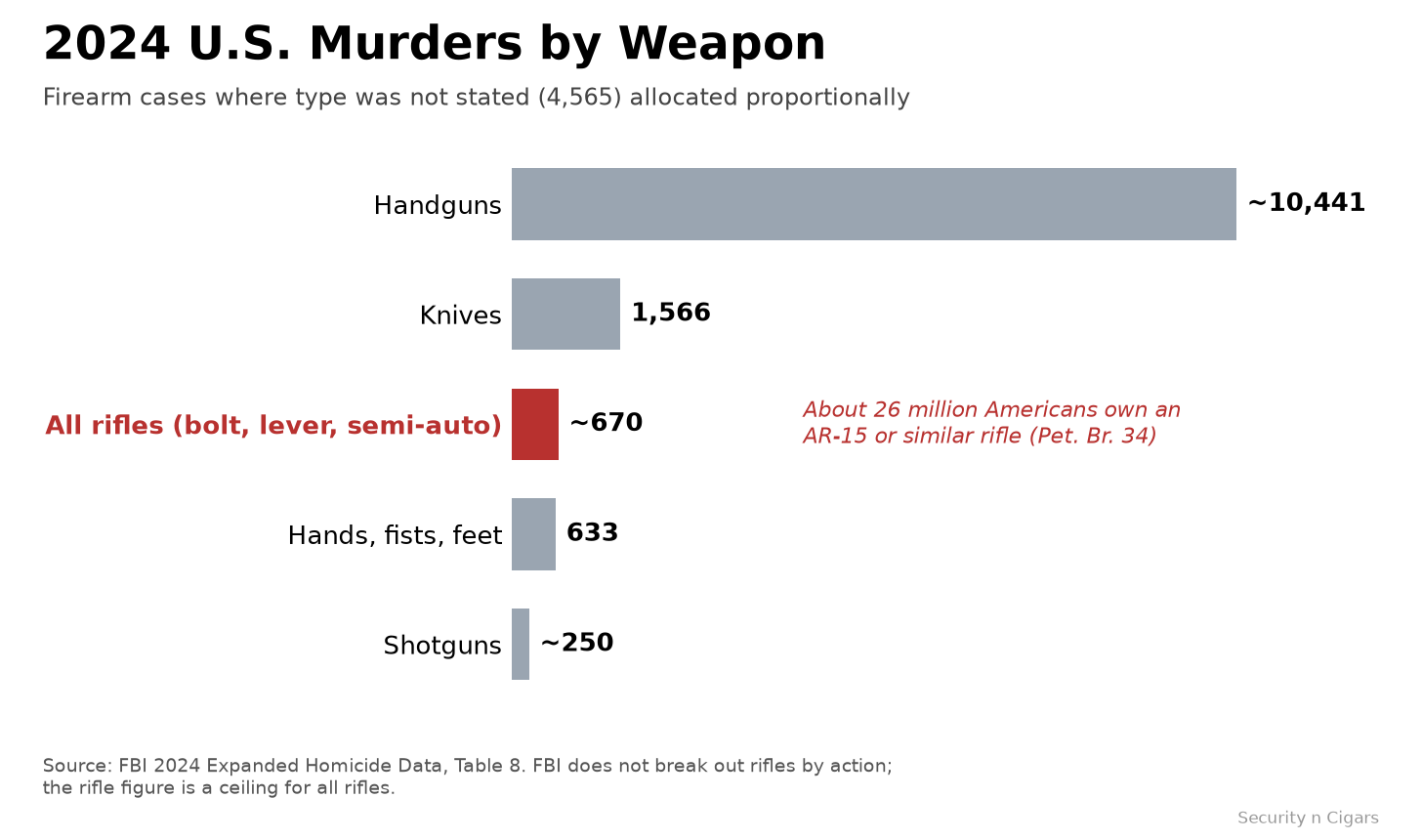
So, about 670 rifle murders. Now look at what else is on that same FBI table. Knives were used in 1,566 murders. That is more than twice all rifles. Hands, fists, and feet were used in 633. That is about the same as all rifles combined.
And the 670 number is for every rifle there is. The FBI does not break rifles out by action. A bolt-action deer rifle, a lever gun, a .22 plinker, and a semi-automatic rifle all land in the same box. So 670 is the ceiling, not the AR-15 number. How many of those were AR-15s? Nobody can say from this data, and the honest answer is fewer. Meanwhile, about 26 million Americans own at least one of these rifles. (Pet. Br. 34)
That is what these bans go after. Not the gun used in most murders. Not even the second most common weapon. They go after a rifle owned by tens of millions of people that shows up in a small slice of a small slice of the murder numbers.
The bans don’t even believe their own rhetoric. If one AR-15 really put the power of an armed battalion in one pair of hands, you would not leave any of them around. But Connecticut let owners keep the rifles they already had, as long as they registered them with the state by January 1, 2014. Illinois did much the same, with an “endorsement affidavit” filed through each owner’s FOID account. Cook County’s own ordinance gave prior owners 90 days to remove the rifle from the county, disable it, or surrender it. Remove it from the county. So the armed battalion is fine in DuPage County. It only becomes a battalion when it crosses the line into Cook.
So it’s a bad choice all the way around. Bad on the law, because the Court has already said arms in common use are protected. Bad on the history, because the founding era punished people who misused arms. It did not ban the arm. And bad on the numbers, because a semi-automatic rifle ban aims at a weapon that shows up in a small share of murders and leaves the big drivers alone.
If lawmakers really want fewer murders, the hard work is somewhere else. It’s in the neighborhoods where so many of our homicides happen. It’s in broken families, missing fathers, and mental illness. If you tackle the underlying causes of homicide and drug deaths, you would also influence the mass shooting issue. Extremely rarely do lawmakers tackle these hard issues. A rifle ban is faster. You get a signing ceremony and a press release. Fixing the real problems takes a generation, and nobody gets a ribbon cutting for that.
The principle the founding era left us still works. Punish misuse, and leave the arm alone. A man who murders with a rifle should go to prison. A man who keeps one in his safe and takes it to the range on Saturday has done nothing wrong. A ban punishes the second man for what the first man did, and it multiplies that by 26 million.
On December 2 and 3, the Supreme Court will hear these cases. The Second Amendment isn’t what’s on trial. These bans are. The question is whether they can pass the test the Court has already written. And it’s whether the Court meant what it said in Heller, in Caetano, in Bruen, and in Wolford. I think it did.
Cook County and Connecticut picked this hill. They picked one of the most popular rifles in America, from a category the FBI ties to only a small share of the murders it counts. They picked a test the Court already wrote, and they asked it to look the other way. In December, we find out whether that hill holds.
My bet is it doesn’t.