

We moved. That was the noun and verb of my childhood, cycling through the rhythm of a career Army officer’s life, where zip codes were temporary and the horizon was always shifting. By all cultural logic, the man steering that life should have been a martinet: a table-pounding, rule-bound drill sergeant of a father who treated his household like an unruly platoon. If you’d watched The Great Santini, you’d have expected the dinner table to be a theater of psychological intimidation.
My father wasn’t that man. He wasn’t emotionally effusive. He wasn’t the kind of dad you curled up next to for a heart-to-heart, and modern therapeutic warmth just wasn’t part of his vocabulary. But he had a rare, quiet clarity about what mattered. When I’d complain about the constant upheaval of military life (“Boy, I wish we didn’t have to move”), he’d look at me with absolute deadpan practicality and say, “Of course, but if you wish in one hand and crap in the other, which do you think will fill up faster?”
Decades later, when I was around fifty, I finally put into words what he’d done: “Dad, you basically taught me that we take control of the things we can control, and we manage the things we can’t.”
He blinked, took a sip of his coffee, and said, “Well, isn’t that obvious?”
To him, it was just the basic user manual for living in reality. In practice, it was something far rarer, especially in a traditional household of that era.
My mother was a wonderful, grounding force, but left to her own devices, she might have erred on the side of caution and kept the world at a polite, age-appropriate distance. In those days, though, my father ran the household, and he used his authority not to enforce rigid conformity but to carve out an astonishing zone of intellectual freedom. He set up what I call my “curious education.” His theory was simple: kids should direct their own education, with very loose guardrails for the things they just couldn’t process yet (like running into pornography at age nine). Otherwise, the field was wide open.
That freedom found its temple every Saturday morning at the local library. Mom would take me there, turn me loose in the stacks, and let me forage. She didn’t stand over my shoulder or vet my reading list.
My absolute favorite children’s books fell into three pillars, all united by one non-negotiable virtue: they treated children like people, just smaller.
Roald Dahl, who understood the delicious, dark justice of childhood and never pandered.
Eleanor Cameron, who gave me aliens my own size and wonderful trips to space.
Heinlein’s juveniles, which never, ever talked down to me, and taught me real science, ballistics, and civic responsibility before I was old enough to drive.
That philosophy was bound to collide with institutional reality. Somewhere around age eight, I was busy pulling heavy, dense history books from the juvenile and young adult stacks. They definitely didn’t belong on the cheerful, brightly colored shelves meant for eight-year-olds. A librarian tapped me on the shoulder, looked at my armload of serious, yellowed pages, and asked if my parents were around.
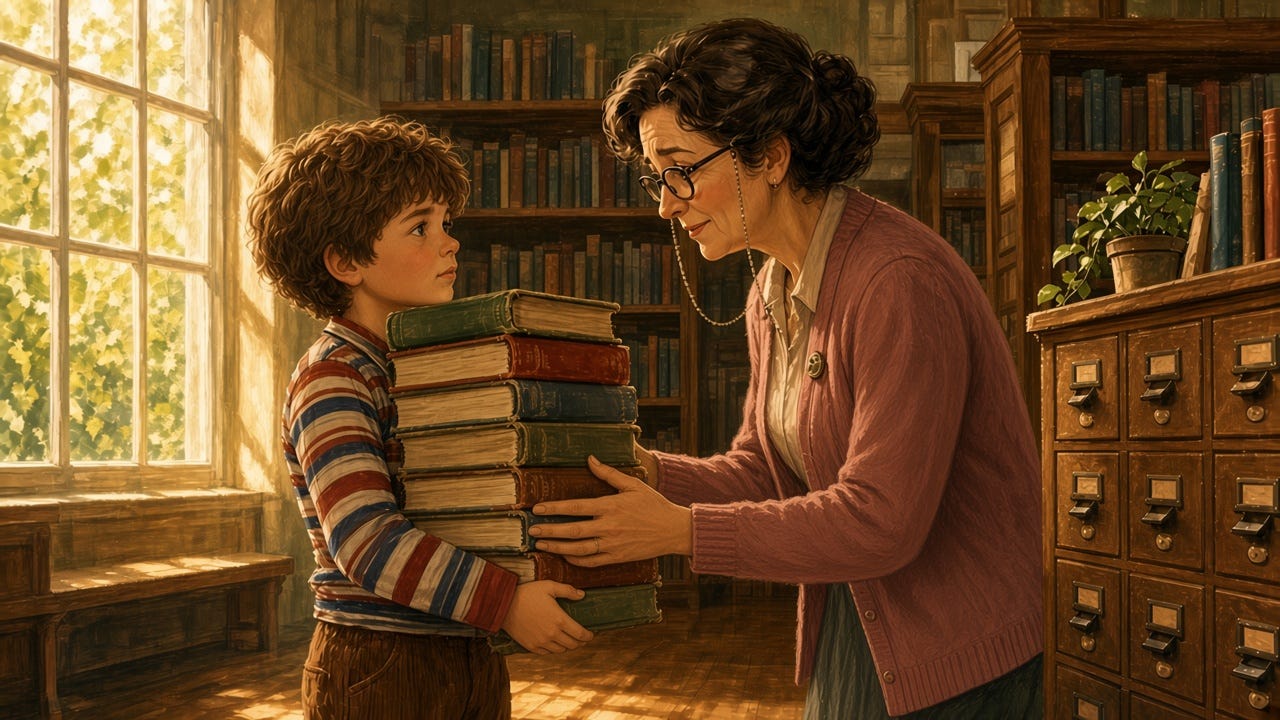
I went and got Mom.
The librarian wasn’t a villain by any stretch. She was a concerned adult with a strong sense of what was “proper” and age-appropriate, and she politely explained that she thought the books were “too old” for me.
My mother looked at her without blinking and said that if I wanted to read them, I absolutely could, and it wasn’t up to the librarian.
We walked out with the books.
Looking back, I didn’t have the cozy, touchy-feely dad of the modern parenting manuals. The emotional distance was real, and freedom always has a price. But I’ve never regretted it, and I’m lucky enough not to need to wish for an upgrade. Between a traditional mother who held the line when it counted and a career soldier father who understood that an independent mind needs room rather than micromanagement, I was handed the keys to my own education early.
They didn’t give me a safety net or a sanitized version of the world. They just pointed me toward the open stacks and left me to figure out how to read it.
Further Reading
Pat Conroy, The Great Santini
Lenore Skenazy, Free-Range Kids
Eleanor Cameron, The Wonderful Flight to the Mushroom Planet
Robert A. Heinlein, Have Space Suit, Will Travel
Roald Dahl, James and the Giant Peach