

On November 19, 1863, Edward Everett spoke for two hours at the new Soldiers’ National Cemetery at Gettysburg. Then Abraham Lincoln stood up and said what the day actually required.
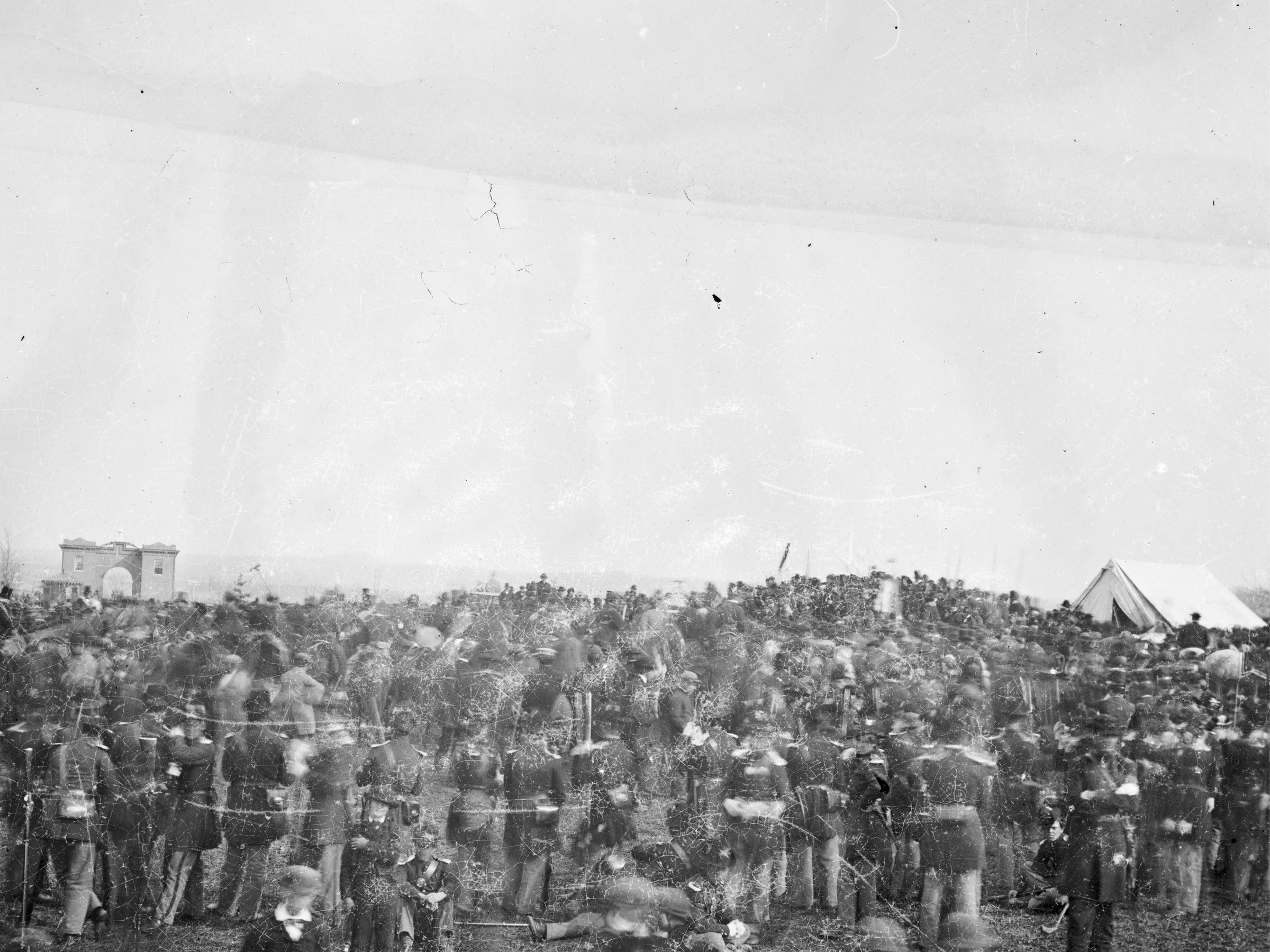
Everett was the man they came to hear. He was a former governor of Massachusetts, minister to Great Britain, secretary of state, and president of Harvard, and one of the most famous orators in the country. A dedication like that, in that century, was built around a long oration. Lincoln had been invited to give brief remarks after it.
I am not going to mock Everett. Long speeches were the custom, and he did the job he was asked to do. He spoke for about two hours. When he finished, the president of the United States stood up.
Lincoln spoke for about two minutes. We know that timing from Everett himself, who wrote to him the next day:
Permit me also to express my great admiration of the thoughts expressed by you, with such eloquent simplicity & appropriateness, at the consecration of the Cemetery. I should be glad, if I could flatter myself that I came as near to the central idea of the occasion, in two hours, as you did in two minutes.
That letter is in the Lincoln Papers at the Library of Congress. It is the best contemporary measure we have of both speeches. I am not going to pretend someone was standing there with a stopwatch.
People still repeat the story that Lincoln wrote the Address on the back of an envelope on the train to Gettysburg. He didn’t. The tale has been repeated for a long time because it makes a nice picture. The evidence goes the other way. Lincoln prepared his major speeches with care. Of the five copies in his handwriting, the earliest one, usually called the Nicolay copy, begins on Executive Mansion stationery. That is a strong sign he was already at work in Washington. The second page is on different paper, and some scholars think he revised the ending in Gettysburg, at the home of Judge David Wills. Even if he did, that is still not a speech scribbled on an envelope on a bumpy train.
The five known copies in Lincoln’s hand are named for the men who received them: Nicolay, Hay, Everett, Bancroft, and Bliss. They are not identical. The phrase “under God” appears in the later copies he wrote out, including the one for Edward Everett, and not in the Nicolay copy, which is generally treated as a pre-delivery draft.
The text most people know is the Bliss copy, written in 1864. It is the last known copy Lincoln wrote out, and the only one he signed and dated. It is also the version carved on the wall of the Lincoln Memorial. People usually call it 272 words. That is the traditional count. Lincoln wrote “battle-field” with a hyphen. If you count that as one word, you get 271. The other handwritten copies differ by a word or two as well. The number is close enough. The point is how short it is.
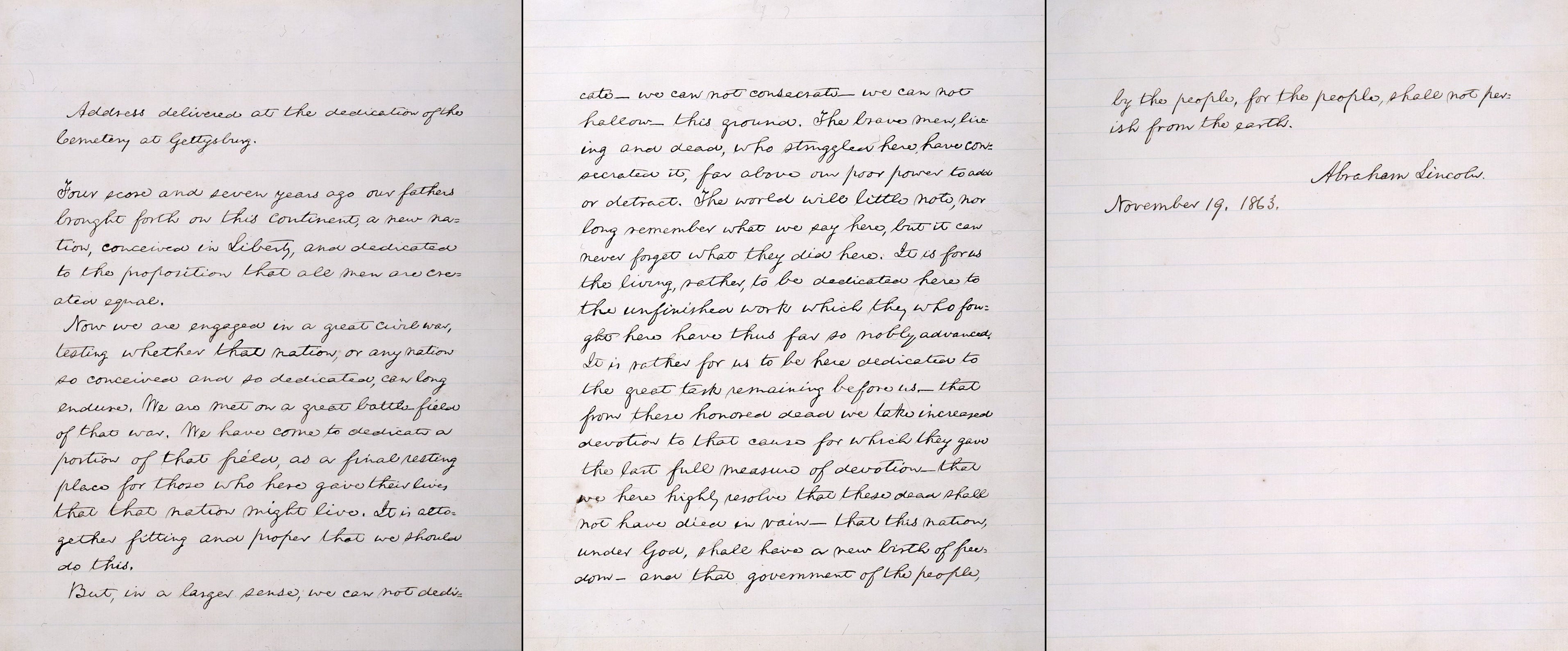
Here it is, from that Bliss copy, wording and punctuation as Lincoln wrote them:
Four score and seven years ago our fathers brought forth on this continent, a new nation, conceived in Liberty, and dedicated to the proposition that all men are created equal.
Now we are engaged in a great civil war, testing whether that nation, or any nation so conceived and so dedicated, can long endure. We are met on a great battle-field of that war. We have come to dedicate a portion of that field, as a final resting place for those who here gave their lives that that nation might live. It is altogether fitting and proper that we should do this.
But, in a larger sense, we can not dedicate—we can not consecrate—we can not hallow—this ground. The brave men, living and dead, who struggled here, have consecrated it, far above our poor power to add or detract. The world will little note, nor long remember what we say here, but it can never forget what they did here. It is for us the living, rather, to be dedicated here to the unfinished work which they who fought here have thus far so nobly advanced. It is rather for us to be here dedicated to the great task remaining before us—that from these honored dead we take increased devotion to that cause for which they gave the last full measure of devotion—that we here highly resolve that these dead shall not have died in vain—that this nation, under God, shall have a new birth of freedom—and that government of the people, by the people, for the people, shall not perish from the earth.
He did not describe the battle. He did not review the campaign. He did not praise himself, or the officials on the platform, or the arrangements of the day. He pointed at 1776, at the proposition that all men are created equal, and at the men who had already consecrated the ground by dying there. Then he turned the day around and aimed it at the living.
That is the move worth studying. The cemetery did not need a long explanation of why the dead were honorable. The country needed to be told that the work was unfinished, and that it still belonged to the living.
I have sat through a lot of speeches, in uniform and out of it. The ones I remember are almost never the long ones. They are the ones where a man knew what he was there to say, said it, and sat down. Brevity is not a trick. It is a kind of respect. It means you have done the work of deciding what matters, and you are not going to make the audience pay for the work you skipped.
We live in an age that rewards the opposite. More words, more posts, more meetings, more explanation. You can talk for two hours and leave people unsure what you believe. Lincoln did the other thing. He trusted a few plain sentences, and he trusted the dead to have already said the rest.
The world did note what he said there, and it has remembered it. Everett saw that immediately. The simpler lesson is the one worth taking home. If you cannot say it short, you may not have said it yet. Do the work. Then use as many words as the truth requires, and not one more.
Further Reading
Gettysburg Address exhibition at the Library of Congress. The exhibit gathers the key documents, including Everett’s November 20 letter and the Library’s two handwritten copies.
The Gettysburg Address at Abraham Lincoln Online. Side-by-side texts of all five copies in Lincoln’s hand, with a clear note on the train-and-envelope story.
As I recall, Lincoln probably showed a draft of the speech to Secretary of State William Seward, who was present at Gettysburg. They came over on the train together and toured the battlefield the night before together. Seward was known to often give Lincoln a critique on his speeches and Lincoln often listened to his advice, though he also generally changed it a bit. Lincoln was very much the better writer.
Also, it's a little known fact that the morning of the speech, Lincoln felt awful. It turned out that he had contracted a variant of smallpox that laid him up for 2 weeks when he got back to Washington. Good thing it was such a short speech! He might not have had the stamina to deliver a long one.
Among the levels of genius bound up in this beautifully eloquent, yet sparse speech is the fact that Lincoln also chose to subtly inform the world’s nations which were hungering for what WE had achieved, that this war was being fought to preserve the Liberty which had at last come to define America.
“The world will little note, nor long remember, what we SAY here, but it can never forget what THEY DID here.”
Lincoln KNEW that this nascent experiment in human Liberty, and its eventual success, was existentially critical to the world’s masses yearning to be free.
He knew that OUR success, or failure, in that sacred enterprise would have far-reaching consequences.